Educator, Thinker and Doer
Former Principal - Peel District School Board & Near North District School Board
PhD - Ontario Institute of Studies in Education - University of Toronto
I am on a journey to understand how my actions as a teacher and administrator have contributed to Anti-Black Racism in our school system. And to understand why we have taken so long to acknowledge it, and to act to counter it.
Our school structures are power structures. Director to Superintendent to Principal to Teacher to Student, we all impose our will on the level below.
Our curriculum is a control structure. Our government and bureaucrats receive input from academics, the business community and post-secondary institutions, and write policy documents that impose strict expectations for each level and subject.
Our assessment structure depends on teachers to design assessment tools, and then to translate the results in marks or grades, which are then used to sift and sort our students. The tools they choose range from traditional pen and paper tests, to oral presentations, to complex portfolio conferences. But each of these privilege students with strong skills, and handicap those whose experiences or life circumstances impact their success.
Our social structures, at least in a secondary school, depend on rules and expectations, which are more easily complied with by students whose toolkit is full.
Our progress is measured by the proportion of achievement to chronological age. A successful student completes the required work in less time than allotted for the course, and an unsuccessful student requires more time. When the course is over it is not just a matter of taking a bit more time. Students must begin again at the beginning, and repeat all of the course, in order to achieve the “credit”. Since students must remain in school to age 18, there is a race to complete all courses before this date. After 18, students who are struggling with attendance or mental health run the risk of being demitted, rather than supported to graduation.
Our budgets cover some of the resources necessary to learn, but not all that is required for all subjects. And there are magnet programs that depend upon family resources to prepare students, to transport them to distant schools, and to furnish additional funds. Doors begin to close in the areas of athletics and the arts for students whose families cannot afford the cost of learning and coaching outside of school.
You will notice that none of this is explicitly connected to Anti-Black Racism. But a system that will tolerate practices that oppress in all these areas is likely to tolerate other forms of oppression.
Until we see each student as an individual, with agency to control their learning, we will continue to exercise unnecessary power over them. If a policy presents a barrier to even one student, we must provide the means to adjust the policy, and support their learning.
This is why it is necessary to start with the systemic policies and processes, to dismantle anti-black racism.
In Ontario, this now means “destreaming” our grade 9 programs, to eliminate the sorting that happens as students move into secondary school, and are set on pathways to University, College, Apprenticeship or the Workplace. This is only the first, I hope, of many changes in curriculum that will serve our students well.
Moves to preferentially admit Black or Indigenous students to regional or magnet programs include the requirement that they “meet minimum requirements”. These requirements are judged both by the middle-school teachers, and by the teachers in the secondary school who review applications. Given that these programs are funded by the Ministry of Education, I struggle to understand why there need to be ANY requirements. It might just be the perception that programs’ requirements can only be met by privileged white students that is limiting the programs’ diversity.
We need to fundamentally change our programs, to make them inclusive and supportive of all students. Whether it’s Italian Art Songs in vocal music, or Ballet in dance, or having the confidence to do a monologue in drama, we need to revisit the content of our courses, and consider if they are truly welcoming all of our students.
We need magnet programs for more than just the academically strong, university-bound students. In fact, the students who need the arts most are likely those who are struggling the most in middle school.
All of this is to say that if we break down oppressive practices and barriers to learning for some students, we might be taking the first steps to dismantling those at the forefront today.
We’re back in Google Meet with C’s class. Today he created a new name card, with letters we printed with the Cricut Maker. He added a hand-cut (by grandma) heart “because I love my class”.
The first activity today is another workshop with the art gallery. Today the teachers enlisted the help of the teacher who joined the class for physical activity and music yesterday. She was much more successful, and so we saw half a screen of the art gallery session, and half a screen of the Google meet grid, with the students’ cameras or images. It was great to see the teachers on camera, but the loss of clarity for the presentation definitely had an effect on C’s engagement. The presenter also never came on camera, so it was difficult for C to make a personal connection. The teachers also invited students to participate verbally, and so there were many interruptions to the presentation as the teachers spoke over the presenter. As well, when the students turned on their microphones, the presentation cycled through and created a confusing echo. I tried to refocus C, but when I encouraged him to look at the screen, he told me “I’m taking a break”.
This reminded me of the “art lectures” that I attended as a student in grades 5, 6 and 7. We would be bussed to the art gallery, and a curator showed us slides of artwork for two hours. We lay on the carpet, and the images were huge. Despite this, I recall falling asleep in the dark. I do remember some of what we heard and saw, but it was a challenge at age 9 to focus. No wonder C, at age 4, is finding this difficult. With no face to focus on, and no interaction with the presenter, it’s a very passive activity. Kudos to the teachers for providing the students with thinking prompts, and inviting them to participate. Perhaps this would have been better to be recorded, so that they could pause the presentation, have the students interact, and then continue with the presentation?
The second half of the presentation was the activity: draw an animal using geometric shapes. The presenter modelled the drawing of a cat out of rectangles and triangles. C related this to a character from one of his favourite Netflix shows, and was very excited by the prospect of drawing his own. He asked me to help him find a picture of this character, which I printed for him, so that he could look at it while drawing. (You can see what other students drew using the hashtag #AGOschools.)
Because of the presentation, the opening activities were delayed. The land acknowledgement was a shared activity with one student, and was followed by an indigenous performance of “Oh Canada” by Asani (https://www.youtube.com/watch?v=MgVqxT3G5kk&list=PLZsHu2W75wCiwyGfogmQdkW5cBZPnkUJA&index=6) C was quite interested in this, and his attention jumped from the drawing he was doing, to the screen.
Then there was a very fast transition to the next activity, which was going to need sticks, something flowy, and a hula hoop. C was still drawing, so it was not easy to redirect his attention. The activity was in a video that was successfully shared, though with our satellite internet it was a clear audio, with choppy video. C looked occasionally at the screen, but continued to draw. He chose to tumble on the bed, rather than do the dance moves with the instructor. When the activity with the scarf caught his attention, he then danced with his paper napkin, and it morphed into an activity of flying and crashes. The video continued to be laggy, so it was difficult for him to follow the motion of the video dance teacher. I think we might have done better with a link to this, that we could run ourselves and pause as needed in order for C to participate.
At this point, I am wondering how this Google Meet is preferable to an asynchronous activity, perhaps like the Bitmoji classroom that is also available to C’s class. Yes, the teacher is sharing the screen, but there is no interaction with the students, and it’s really not a lot different from watching a video on YouTube or Netflix.
C’s drawing turned out well, and I have shared it above. And the dance video went on as he completed his work. I used to tell my teachers that our grade 9 students needed to have activities chunked into 15 to 20-minute sessions, in order to sustain their attention. After 30 minutes C found that tumbling on the bed was better physical activity than the video, which is really more like a series of stills due to the internet lag. Maybe music would be helpful?
It was snack break, as of 10:45. Because the teachers have a 1:15 meeting they decided to do activities after snack. Then lunch from 11:30 to 12:30. So we headed outside, to rejoin the class later.
An hour later, and C was continuing to play outside, after eleven runs down the hill on the toboggan. We were hot and sweaty, but happy with the physical activity. Not sure what those whose parents are working full-time from home were doing; I can’t imagine that it’s easy to keep their children occupied for almost two hours!
So, at 12:45 we were back in the Google Meet, having posted his artwork to the Google Classroom. Without a helper at home, this would not be possible. As we arrived, their teacher was explaining to the students how to make a Bingo card, if they haven’t been able to find the cards that were sent home with them on the last day before the Winter break. They were asked to make eight boxes, and put it any number between 1 and 20.
C had his cards, since his parents sent his school backpack with him to our place. He was very excited to be playing the game, though the pace was a little slow for him. Thankfully the pennies we chose as markers made good fidget toys! However, he also discovered that the antique student desk has a sloped top, and so kicking his seat caused an “earthquake”, and his pennies slid down off the card. We’ll take learning any place it comes! When the bingo finally was called, almost all the students shared the glory. And the teachers asked each in turn to read out their numbers. This took some time, with many reminders to turn microphones on and off. Interspersed with the conversation were several renditions of the song, “BINGO”!
This was followed by the message of the day, contributed by one of the students. She needed a bit of help with the reading, but it included a question that puzzled the teachers who weren’t sure if it was a riddle, joke, or a serious question. The next thing to share on the stream was a picture from another student, drawn after her walk today at lunch. The third share was a students’ artwork from this morning; a beautiful cat made of rectangles, triangles and straight lines. C was next, and he was able to describe the shapes he used, including the heart. The fourth share was another cat, and again the artist was invited to describe her process. When the sharing ended, C decided he needed to see the screen bigger, and accidentally closed the meeting. He had been sitting for 70 minutes straight; an accomplishment indeed!
After a break in the hot tub, with shower wall drawing, we headed back to see then the class would resume. The stream in Google Classroom said that there would be a “read-aloud” at 2:35, so we planned to return then.
Back in the Google Classroom at 2:30, there was no link to a Google Meet, so I had to explore. I found the page for the Teacher Librarian, and halfway down the page was a posting for the Tuesday and Thursday Read-Alouds. We clicked on the link, and it took almost four minutes for the MS Teams interface to load. We were greeted by a slide, and the sound of static and typing. The question posed was good, but I’m not sure that many of the JK students would have been able to figure it out without someone reading it aloud. Eventually the TL switched to her face, and asked the question. Many of the students responded to the question in the chat, but as a non-reader, this meant that C was sitting and waiting long beyond his limit. When she began the story, it was nice to see her using a physical book, rather than digital images. But it would have been nice if the software could have shared the image alone, and removed the document camera navigation. With the book on the left, and the TL’s face on the right, there was no way that the text could be read, as the book’s footprint was less than 25% of the screen. Perhaps a setting would have allowed for a “picture in picture”, so that the book could have possibly been read-along by the students. Between this, and the reflections on the pages, C only lasted about five minutes into the story before bailing. I stayed, and tried to imagine myself as one of her primary students, trying to see the text and figure out which words were the story, which were her explanations of the story.
I made the decision that we would return to the classroom following the story, despite C’s protests. He joined in, turned on his mic, and then began to make silly faces and sounds. I heard others in the class saying “when are we leaving?”, “Hi”, and again “when are we leaving?”. C continued to sing, and insist on his mic being on, despite my prompting. The teachers asked students to share what they remembered about the story, but it seemed only one student actually listened to it. She gave a strong recounting of the plot, and was obviously engaged. But at the same time, C was saying “I’m tired of doing this, I’m tired of school”, so we chose to leave the meeting.
Here are my thoughts on today’s experiences:
I know that reflection is the best way to learn, but I suspect that our teachers have no time to do so, with all the preparation they need to make, and all the intense interaction they must undertake with their students. But perhaps hitting “record”, and watching just a few snippets from the day’s activities would be informative. By viewing the recording they would be able to see the experience of their students, could focus on particular students’ faces, and could consider what’s working, and what needs revision. Inviting our board resource staff to join in, and contribute, might be worthwhile.
I wish there were a way to ensure that each child has an advocate at home, to assist them with the interface. It has been a significant amount of work just getting C to class, and refocusing him while he participates. I cannot imagine what it is like for parents who are also trying to complete their work duties at the same time!
I also think that a daily agenda, with the timings provided, would be very helpful. As a caregiver, I would also like to know which of the day’s activities were important and which were nice-to-do, but not crucial. For a child with limited attention, this would support a more positive attitude, and possibly greater attention, if we could avoid the “waiting”.
As for timing, we know that the mornings are best for learning. So, perhaps the teacher-student interaction could be increased in this time, and the video activities rescheduled to later in the day where the students could be more passive consumers. By 3:00 today, C was tired, and ready to view rather than produce.
I can think of so many ways in which our teachers could be supported, to allow them to do what they do best: interact with their students. They are SO patient, and are responding positively to every student. In these past two days I have not yet heard one of them get frustrated. How do they do it?
And I’m sure that parents are unsure how much, or how, to support their children. I don’t know whether to redirect, or to leave it to C and his teachers to manage how he works online. Perhaps he doesn’t need to actually be there in front of the screen; maybe having the computer on while he plays somewhere in the room is enough? If I, as an experienced educator, have these questions, I cannot imagine how many more our parents have.
What do you think? How much support should I be giving C?
Today is Day One for me as a “personal teaching assistant” to my four-year-old grandson, C. He’s in Junior Kindergarten, and his class has been fully online for a week. However, C wasn’t able to participate without the assistance of both his parents. And since they are working full time: Mom as a synchronous secondary school biology teacher, and Dad as an engineer, he hasn’t been in school. So, C has joined us in our home, so that we can hopefully participate in his synchronous junior kindergarten class.
We prepared yesterday by opening his email account, and reading through all that we missed last week. Then we joined the Google Classroom, and reviewed, again, what was missed. I couldn’t find the link to their class Meeting, but was reassured by my daughter-in-law that is would appear for today’s class to begin.
Today we set up early. C has a small desk (too small for everything he needs), but it has a low shelf that he can rest his feet on, so he’s fairly comfortable in his chair. There is a bed nearby, and it’s useful for tumbling breaks, which is taking frequently.
For attendance, he had to create a name card to show. This fit well with the first activity that he chose from the Bitmoji classroom: cutting out letters from packaging. So, he glued the letters of his name to paper, and was able to hold it up for attendance. He was acknowledged by his teachers, though they were concerned that he was “cutting out”. So, I opened the mic and shared that we were connecting via satellite Internet, and likely would be somewhat slow responding.
The land acknowledgement went well, with one of the students assisting with the reading from slides that were shared with the group. I am so impressed at the reading levels; when I was in kindergarten the expectation was to know the alphabet and count to 10, but that’s
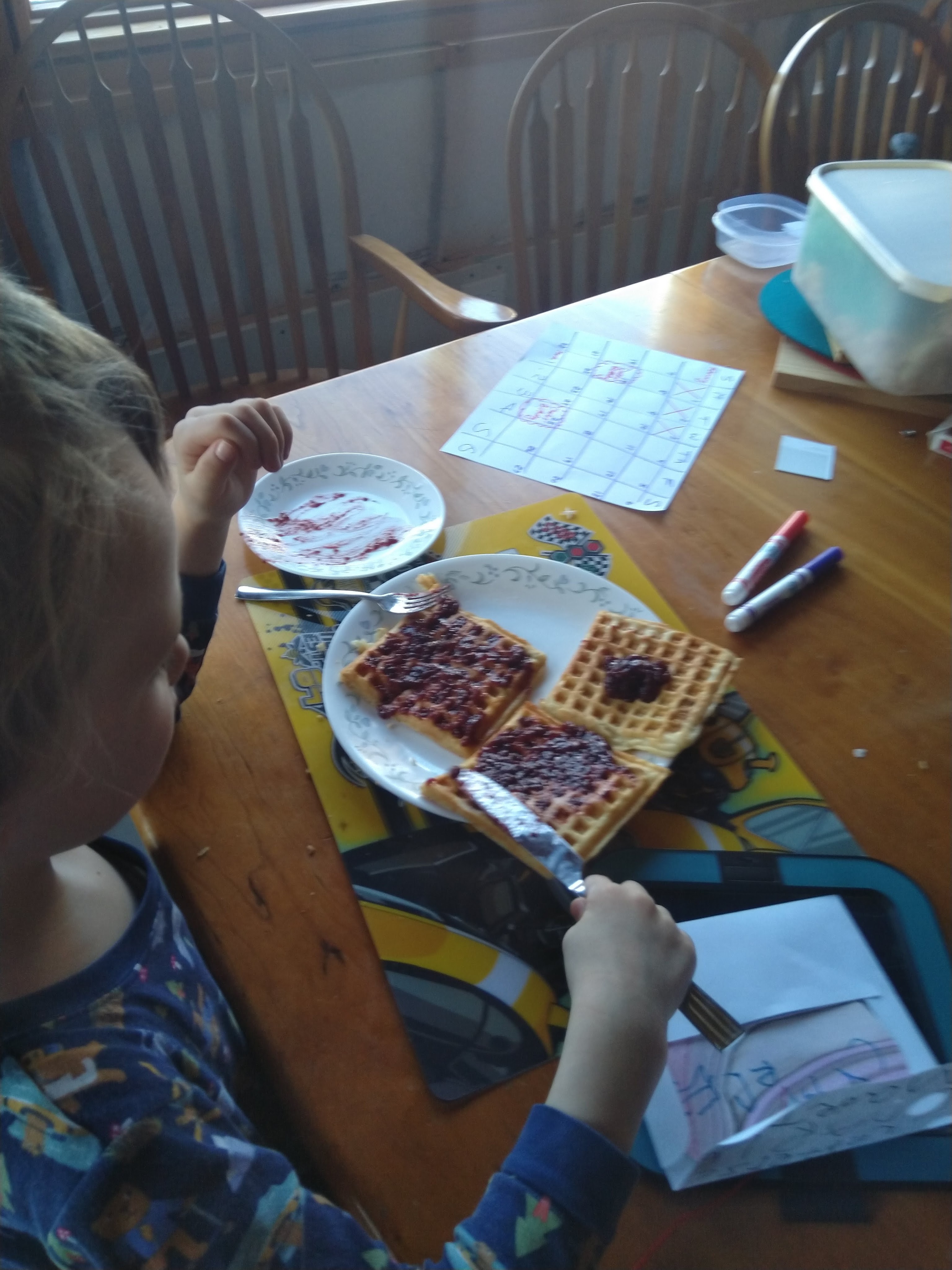
Next on the agenda was a virtual visit to the art gallery, which was being presented in Zoom. It took 20 minutes of trial and error, trying to share the Zoom presentation in Google Meet. The final solution was for one of the teachers to hold her iPad up to the camera, and it worked! However, by this time the audience was restless, and my grandson needed a great deal of redirection to listen and watch. You can see his solution in the picture at the top of this post.
The activity that was part of the art gallery presentation was really fun, and the teacher was able to do a quick demo. My grandson was able to do the activity with verbal assistance from me, and his response was “This is really cool!”
But instead of letting the class finish the activity, they had to catch up with the agenda, and begin the activity break, where a different teacher joined them in the meeting. C agreed he needed a break, but was entirely unwilling to do the body movements she was modelling on screen. Her music was very faint and his Chromebook screen so small, that his attention was easily lost. When she began asking for student participation we went back to gallery view, and it was harder for him to find the teacher among the faces. When a question of “what movement has the letter m?” was asked, C responded “swim”, and his teacher responded enthusiastically. What a difference in his engagement when she reacted directly to him, and acknowledged his vigorous movement! He still needed a couple of “bounce on the bed” breaks, even with the active movement, be he participated a good deal of the time. Her last activity was a video share, and we could hear it, but the video never appeared. A bit of problem-solving in the chat revealed that having “pinned” the teacher, what she shared in video would not be visible.
For the 15-minute break he chose to eat, and continue to watch the exercise video… so it really wasn’t much different than being in class! Then, when the video ended, all we saw were some empty rooms, so he went to his tablet to play a game.
Back from the break, they were asked to share their artwork. And then a long conversation among the teachers took place, with a discussion of the relative merits of Flipgrid and Jamboard, that likely was not relevant to the students who were sitting there, waiting for direction. This is important for the activity posted in Google Classroom, but I think it should have been worked out in the background, not while the students were waiting. I stepped in and tried out the login, and confirmed with the teachers that it worked. So, almost 15 minutes later, she began her presentation. However, she was trying to redirect a flip grid video to present and, again, we couldn’t see or hear it.
The task was to create a math story, and create a Flipgrid question for their classmates. So we took a break, went to Flipgrid, and after five attempts, had a short video to submit. It was fun to watch C’s process, as he tried out different ways of saying his “math story”.
We returned to the class meeting at 11:15, and by now C was very unfocused. One of the teachers recognized this, and suggest that they do independent learning to 12:00, with the teachers available for support. This would be followed by lunch from 12:00 to 1:00. We decided to do the ‘igloo’ activity from the Bitmoji classroom, and take it outside to make a real igloo.
The igloo benefited from the large, plowed yard, with lots of compacted snow. We were able to use a small handsaw, and cut blocks. Unfortunately, the snow is still quite cold, and did not compact nor adhere well. So, we emptied a cleaning spray bottle, put in water plus blue-coloured flavouring, and headed back to add water to the seams. We’ll see tomorrow how it stands up after a below-freezing night.
The break for exercise and lunch was appreciated, but the transition back to school received “What? There’s more school? I don’t want to go back.” C was playing a game on his tablet, and would only return to his desk with the promise that he could bring the tablet along.
He shared with his class what he had done during his break, and was very excited that they encouraged him to post pictures. After about 10 minutes of sharing the teachers said they would be online, but that the students could work independently or interact with them. C chose to leave, and I believe that school is over for the day.
We’ll be back again tomorrow morning, and in the meantime I am going to try to figure out how to share his photos in his classroom, so that he can talk about the process with the class. I really do wonder about the time spent sitting, and how I might help C focus to participate more fully. However, kindergarten has never been about chairs and watching, so I don’t think that “bailing” for the afternoon is such a bad idea after all.
If you’re teaching Kindergarten online, here are a few suggestions from both of us:
Find the “mute all” function, and be prepared to use it regularly to manage the noise level.
When on camera, connect visually with your students. If you need to work off-camera, turn it off.
Be sure your students know that if you “pin” the teacher, you won’t be able to see the video that is being shared.
Telling students who can’t read to come back at 10:45 is unlikely to be successful. I would suggest a countdown timer on the screen would work better with 4 and 5-year-olds.
If you are a teaching team, consider setting up a backchannel for your technical conversations, rather than talking over the students. It would have been very helpful if the various teachers we met today had been able to work via texting, phone, or other media, to problem-solve their technical issues or to negotiate the agenda and timing.
Consider the “real estate” available, and when having a “full screen” might be helpful to your students, rather than the gallery view of everyone’s image. This is especially important if you have students using phones or small tablets to connect.
As a former teacher, I am amazed at how our current reality has served to “deprivatize” our practice. There are kindergarten students on screen, but behind them are the parents, grandparents, and caregivers who are assisting. And each of them is learning about teaching and learning in a way that was not possible in the past. I believe that when we return to “normal”, our relationships with our communities will be forever changed by this experience.
It was announced this week that elementary students in Ontario will remain at home until January 25. The original plan was for one week only, then a return to F2F learning in schools. In our family this meant only one partial day of learning for our grandson in Junior Kindergarten: he hung up on his class by mistake, and wouldn’t go back. And with both his parents working full-time from home, he was left to his own devices for much of the following four days.
So, since he will be at home for another two weeks, I offered to have him move in with us. I picked him up on Friday, and I am already getting to know the idiosyncracies of the four-year-old brain. He loves to multi-task: eating while playing with cars, playing with cars while watching Netflix, watching Netflix while trying out tumbling moves on the carpet. None of this promises to work well with a Chromebook and headphones when he returns to class on Monday.
His parents, one of whom is teaching two classes of grade 11 Biology synchronously, weren’t able to sit next to him while he participated in his class Google Meets, nor assist him to navigate Google Classroom as a pre-reader. I’m not sure if I am going to be any more successful, but I am going to give it a try.
Here’s what I am going to do, hoping for better success for him:
Create a standing desk for him, with his Chromebook at eye level.
Set up the microphone and speaker in the Chromebook, so that he isn’t tethered to the device.
Seat myself at a desk next to him, for my parallel work. I will be able to view his screen, hear his teachers, and generally monitor his interactions. But I will be working on my computer at the same time, so that he doesn’t feel isolated.
Provide a table next to him, with fidget toys, small puzzles, and other items that he can use if his mind wanders.
Allow him to leave it gets to be too much.
Our Kindergarten programs are play-based, and there is little in the online environment that supports this approach. However, his teachers pivoted to remote learning last March, with mostly asynchronous content provided via Google Classroom, and so they will have created rich resources. In September there were elementary online schools created for families who chose not to send their children back to physical schools, and there is now a huge pool of expertise and experience. His current teacher and early childhood educator will be able to learn from their experienced colleagues, so I am confident that the instruction will be strong.
My main concern is his attention span. I have watched him devour video content, but when he does so it is usually in 10 to 15-minute chunks, and usually with a great deal of physical movement on his part. There is no HDMI output on the Chromebook, so I can’t even attach a larger screen, as I had originally hoped. This would have made the teacher and class visible anywhere in our room, and would have allowed him much more physical freedom to move.
So, I will try to mitigate the limitations of the small screen, untether him from the audio, and we will see how it will go. We will build in lots of physical activity in the nutrition and body breaks, and Grandma will benefit as well.
Wish me luck! (And please send me any suggestions you might have.)
It’s mid-December, and I know that the Teacher Candidates who began our pre-service program imagined a very different reality than we know today. They were promised a program of teacher-preparation, with placements with Associate Teachers which would prepare them to enter classrooms upon graduation.
Instead, they’ve had to pivot their university courses from face-to-face, to Adobe Connect and Zoom. They’ve missed their second placement entirely, as it was to begin the day that lockdown began in March. And now they are in placements in secondary schools with teachers who have limited experience with Google Meet, PearDeck, Brightspace, and all the other tools of their new remote/hybrid/online classrooms.
It’s one thing to “train” for a job; and it’s another to figure out the job while doing it. Both our Associate Teachers and our Teacher Candidates are in the middle of a steep learning curve, and boy, are they learning!
Some boards have asked teachers to teach fully online. This is the simplest model, and one which our Teacher Candidates have experienced during their third term as students. They have developed a strong toolkit, and have had excellent models in their university professors, and so they’re doing a good job when they land in these classrooms. Their students, however, are novices with the technology, and so they’re having to teach both the course content, and the tools with which to learn.
Some students are in traditional classrooms, but the students are physically spaced, wearing masks, and attending in person for only some of the classes. These students also have synchronous online classes, as well as asynchronous assignments where they work from materials within their learning management system (LMS), such as Google Classroom or Brightspace. Building community, supporting social learning, and monitoring individual student progress is a new challenge.
Many students are in hybrid settings: the teacher has some students physically in the classroom, and the rest of the students online, both at the same time! This requires accessing two very different set of tools, and trying to deliver them simultaneously. Some of the students are able to provide real-time, valuable feedback throughout the lesson, and others are merely muted names on the screen.
The most challenging scenarios I’ve encountered are physical and health education classes, with as few as two or three students in person for a 2.5 hour block, with the rest of the class at home without equipment. They signed up for “phys. ed.” and they’ve ended up having to do a lot more reading and writing than they anticipated.
This move to larger blocks of time was designed to minimize the overlap of cohorts within schools, but they have created learning sessions that are far longer than most teenagers can manage without distraction. I hope that reflection on the part of school leadership might result in new models that permit facility-dependent programs such as physical education, nutrition, construction, etc. to bring more groups into the school to use the space, throughout the day.
I’m hearing from my students that these learning teams of teachers are having to experiment, reflect, and problem-solve every day, to try to meet the needs of their students. Teachers are questioning the use of traditional assessment tools, and worrying that the challenges of slow internet, lack of access to technological tools, and limited support within their students’ homes might be roadblocks to their students’ learning. They are finding new ways of teaching and assessing, and I hope that they will soon begin to share their successes and support their colleagues to adopt these new strategies.
As I conference with my students, viewing them either live in Google Meet, or recorded in their classroom, I am hearing that they are working harder than they ever have. And they are learning more than they could ever imagine.
We are graduating an amazing group of young teachers this December.
As our administrative oversight duties for our Online Secondary School have dwindled, I’ve begun to consider what might be our next challenge. It was exciting supporting teachers as they shifted to a fully-online model, but I am less excited about supporting them as they return to an adaptive or hybrid model in their home schools for Quadmester 2. So, I have chosen to conclude my duties, and reserve some of my remaining available work days for the next exciting challenge.
I am very proud of the online school that we have built, and of the teachers who have made it such a success. Here are some of the reasons why I think that this model has worked:
Online Teacher Networking
Our online teachers have been drawn from more than 30 different secondary schools and from our long-term occasional team of teachers. They have come together, most never having met each other, and have built course and department teams that have shared resources and supported this new model of instruction. As they return to their home schools, they will bring with them a rich toolkit and strong connections to their colleagues.
Online Student Agency
Our online students have been guaranteed that 25% of their program is self-regulated. They see their teachers for 3 full periods every two days, and have one period in which they work at their own pace utilizing materials from their LMS. This has provided them with some flexibility, while developing their self-regulation skills.
Online Consistency
The timetable for our online school has allowed for consistent sequencing and scaffolding, so that teachers who teach two classes of the same course can proceed with both in the same order. In the current adaptive model, teachers see one cohort in the first half of the week in person, teach synchronously in the afternoons, and then see the second half of the class in the second cohort in the last half of the week. This means that any hands-on activities are either conducted in advance of the theoretical lesson, or afterwards, but rarely will they encounter the cycle of theoretical and hands-on in the same order.
Our online teachers have been able to establish routines and norms and consistently reinforce them in each class. This creates a safe environment for learning, and minimizes frustration for both students and teachers.
Online Tools
Our online teachers have developed facility with either MS Teams or Google Meet, and with Brightspace/D2L or Google Classroom. They have added Padlet, Mentimeter, Pear Deck and Bitmoji classrooms, and experimented with other online tools to enhance their instruction and assessment. With these tools, students can easily access class materials while in class, and when completing homework tasks. They do not need to shift from digital to paper, nor from screens to in person.
Online Efficiency
Our online students can sleep in, and arrive in class on time in only minutes. And when they conclude their class, they can immediately move to their chosen activity. Those attending in person are spending time in transit, in sanitizing activities, and dealing with interruptions that come along with in-person group activities. Other than technological failures, interruptions to class flow are rare online.
Online Organization
Because course tools and materials are organized by the teacher, students who struggle with organization are better supported. There are no more crumpled papers at the bottom of backpacks!
Online Professional Learning
Our online teachers have risen to the challenge, shared best practices, and sought out new strategies. We enjoyed several teacher-led workshops, entitled “Log and Learn”, over the past two weeks. Their modelling of their classroom practices provided our teachers with inspiration. I was impressed by each teacher’s presence online, their strategies that enhanced their students’ engagement, and with their positive approach to online learning.
Online Student-Student Connection
Our online students benefit from teachers’ support of collaborative activities, through the use of breakout rooms, threaded discussions, and other digital tools. Because they know that their students may not know each other, they have added activities to support connection and building of community. And while the lesson is in progress, students can utilize Chat functions, or other back-channel tools, to connect with each other without distracting the entire class. No more side conversations, or passed notes!
Online Student-Teacher Connection
Within their digital environments students see their teachers’ faces and class materials clearly. Most of the time the teacher’s face, or the tools they are manipulating, are the sole focus on the screen. Their focus can also be directed by the teacher to others in the class as they contribute to the lesson. Chat serves to provide in-the-moment connection, and email is a necessary tool between classes.
Online Success
At midterm, we saw instances of high achievement in many classes. We questioned this, and challenged teachers to share their assessment data, and to explain how they determined midterm marks. They reported that they had students who were able to fully explain concepts, and make connections and apply their learning. They had triangulated their data, and it indicated that many students were achieving much greater success in this online environment than they had been in person.
Of course there were also the other extremes. Most of these were challenges of attendance and of technology, both of which are “fixable”. We need to know more about those who have not succeeded in this environment, and how we can better support them as they move back to a hybrid model.
I am very worried about this new hybrid model, and concerned that it will lose the benefits of the current F2F classes AND lose the benefits of the fully online model.
In my last post I wrote about “gradual release of responsibility”, and now it applies to me.
Last week was mark reporting, and so we were busy supporting teachers to enter marks, and ensuring that report cards were distributed via email to our students. Among our teachers are some with years of experience, alongside those who have never determined midterms marks. So it was a busy time, with many emails back and forth as we supported and educated.
We’ve now had three teacher-led workshops: each one providing our teachers with new tools to bring to their online classrooms. I am so appreciative of the efforts our teachers have made to share their expertise.
While not nearly as experienced, I’m going to be co-facilitating a workshop later this week, and again the following week, working with another instructor from Ontario Tech University to share best-practices in online secondary school instruction. Her work is based upon that of Garrison, Anderson & Archer (1999), which was developed in a text-based online environment, but applies equally well to our multi-media synchronous environment. We will be engaging with secondary school teachers, making connections between this theoretical framework (see illustration at top) and their daily work.
If you’re interested in this, or other workshops, please check out https://ote-shareconf.weebly.com/. Each session is 90 minutes in length, facilitated by Ontario Tech University instructors and friends, and costs $10.00.
Back to the “release”. My work has been “dwindling”, and I’m spending my time responding to emails that could easily be managed by others on our team. I have no exciting challenges on the horizon, and so I am preparing to head on. There are those on our team who will be continuing to support our Coop program through a full semester, and to manage the shift of some of our most vulnerable students into the new model. But I am seeing myself without any agency to influence our program and processes in Quadmester Two, and I am feeling useless.
Our online teachers will be bringing a huge toolkit back to their “brick and mortar” schools, having instructed synchronously 75% of the time, with strong asynchronous content for the remaining 25%. They have worked entirely online, both with their students and with colleagues and admin. They have juggled new tools, with little training or support. And they have thrived. One teacher told me that he didn’t know why so many of his students were doing so well in his class. He was triangulating his assessment data with conversations and observations, and they were still exceeding all expectations. He said “What should I do?”. I said: “I guess you celebrate!”
With the new demands to teach to both the students in front of them in the classroom, and those online at the same time, they are facing new challenges. If the hardware and connectivity work, I know they will succeed. The challenge to connect students in all three cohorts, and build community, will be a greater challenge than that of instructing. Teenagers crave connection, and they have been starved since March. Bringing online tools and expertise to the F2F classroom should begin to address that need.
I wish our teachers well as as they embark on Quadmester Two in mid-November. They have proven themselves, and should be proud.
This is our goal for our students in their learning. As an administrator, it is also my goal for my teachers. We are now reaching the mid-point of the quadmester, and if my inbox can used as a measure, we have been successful.
Teachers are now busy reviewing their assessment data in order to report mid-term marks. The Ontario Ministry of Education has given school boards permission to modify traditional reporting processes, and in some boards this means there will be no midterm report cards. In our district there are report cards, but they will be missing any learning skills or comments. This reduces some of the workload for teachers, but increases the potential questions parents and students might have, where a comment might have served to support a particular mark on the report.
We are also seeing an increase in teacher-to-teacher support, including workshops where they are sharing best practices. Yesterday’s session, presented by one of our online science teachers, attracted more than 150 teachers. We met in MS Teams and learned how one teacher is leveraging his tools to support student learning and engagement. While it was advertised to be an hour in length, it was more than 50% longer as teachers participated in a lively Q&A. I joined in from a service station parking lot for the full two hours from welcome to conclusion.
In our admin team we are also streamlining our responsibilities, and shifting our work to those best-equipped to resolve issues. When it was proposed that we each run a simultaneous staff meeting, to send consistent messages to our teams, I was successful in lobbying for a single event. Since any meeting was going to be more like a presentation than a truly interactive “meeting”, I argued that we would do a better job with one presentation, with all 500+ teachers in attendance. We could then follow up with smaller meetings, so that teachers could truly “meet”, and interact with us. (The smaller meetings will be planned to take place after mark reporting concludes next week.) After six or seven rehearsals, we somehow managed to do a “live” event, with one administrator speaking, a teacher-leader presenting the slides, and I, as producer, determining what would be streamed. As a first attempt it was a little rocky, but we did hold the event, and were able to generate a video for those who arrived late, or could not attend. We are learning, learning, learning!
Our work this week, and for the next, will be to support those whose trajectories haven’t been consistently onward and upward. We still have teachers who believe that email counts as synchronous instruction. And those who believe that a hard deadline of 2:45 pm should be enforced. And those who are struggling with issues beyond their control, and don’t yet know who can assist them. I will continue to welcome their emails, and work with our team to ease their way.
To complicate matters, word has gone out to our system about a change as we move into Quadmester 2. I know this will generate concern among our school, among our “bricks and mortar” colleagues, and among our entire student population. I am in a difficult political position, as I try to make sense of this. My experiences as a teacher, system leader and administrator, as well as my observations over the past six weeks, put me in a difficult position when I consider the prospect for November. I will have to decide how much of a voice I should choose to exercise, and whether it could have any impact for good.
My work teaching pre-service teachers will also be coming to an end in December. They have chosen to create much larger classes with correspondingly fewer instructors for January. And as I am new to the role, I’m first out. So I will be looking for new opportunities, come the new year.
So back to today. I’m finally logging my first two days this week that are truly 0.5. But I am making sure that the half-day is spread out over the day, so that I can respond to emails within a timeline that is supportive of my teachers. It’s similar to my cycle as a Principal between walking the school, and answering emails at my desk. I was a lot healthier doing the walking than I have been sitting in front of a computer for the past six weeks!
As we head into the weekend I hope that I can figure out a plan to increase my physical activity, while still remaining supportive of our teachers. And I will search for a way to support my mental health, and that of our teachers, as we forge ahead. Perhaps I need to “release responsibility” a little more effectively!
I started Day 30 with my usual trip through my Inbox, addressing questions from our teachers before the school day began.
Then our admin team met with one of our teacher leaders, who has been working with us to prepare for next week’s planned staff meeting. About 10 minutes into this meeting I was feeling overwhelmed by the task of taking a slide deck created by someone else, speaker notes that were becoming too dense to read easily, and a new-to-me medium of MS teams to meet with my designated group of teachers. My suggestion that we create a live event, rather than multiple simultaneous sessions lead by each of us, was thankfully adopted. It’s still going to be a new experience for us, but we can focus our efforts and communicate a single, consistent message to our school of more than 500 teachers. We will also have time to do a “dry run” on Tuesday, so that we might encounter fewer glitches for the real meeting on Wednesday.
When I made it back to my inbox, and my daily check of Facebook and Twitter, the conversation had grown around the rumoured changes to our instructional models. I spent some time in conversation on the phone with one teacher regarding her concerns about the possible switch from fully online into a hybrid model. I was, again, reminded of our teachers’ dedication to their students; this teacher has accommodations to work from home, and so is guaranteed to remain online. Her worries are for our districts’ students and teachers.
A few weeks ago I challenged Jennifer Gonzalez (@cultofpedagogy), author of the Cult of Pedagogy blog and podcast, when she asked for suggestions to improve teaching online and in hybrid settings. I was looking for ways for teachers to improve the student-to-student networking and communication, prioritizing it over the transmission model from teacher to student. She rose to the challenge, and her blog, How to Teach When Everyone is Scattered is a gold-mine for teachers faced with what appears to be an impossible task. I met Jennifer when she was a keynote at our board’s summer conference for teachers several years ago.
I am not going to repeat her content here, but I will summarize her key points:
Create Student Cohorts
Limit the Synchronous
Chunk the Time
Build Community Intentionally
Experiment with Cameras and Screens
Optimize Discussions
And she concludes with advice that I wish I had written: “Consider teaching in a post-COVID world to be the most massive project-in-Beta ever. It’s going to be messy, but that’s how humans learn and grow and adapt. Continue to experiment, fall apart on the days when it’s your turn (because everyone seems to need a turn every now and then), ask students and parents for feedback, observe other teachers when you can, and most importantly, keep giving yourself and your students grace.”
As we head into our Thanksgiving Long Weekend here in Canada, please give yourself grace. My grandmother was “Mary Grace”, my mother is “Bette Grace”, and my husband and I named our daughter “Emma Grace”, and its meaning has become stronger to me in the past eight months of this pandemic. Merriam-Webster provides 17 definitions of grace. In its biblical roots, grace refers to mercy and forgiveness. In its more modern definition it may be used to mean ease and suppleness.
After more than a week of delays, then finally a memo outlining our reporting process, there is now an entire “about face”. I can’t share it, because I’m not the official “messenger”, but I know it is making the rounds in Facebook and Twitter.
And yesterday’s post seems prescient: many of our Ontario school boards seem to be ready to opt for the worst of all worlds: a hybrid model where a teacher has to teach TWO groups at the same time, one in front of them in person while at the same time juggling the other group online within MS Teams or Google Meet.
I am seeing wonderful learning happening in our fully online model. And I saw tired, but happy, students in their double-periods in face-to-face settings. Both had the benefits of some asynchronous learning, and synchronous lessons with the full class of up to 34 students.
Now our successful online model is at risk of being downgraded, with teacher attention having to be split.