Junior Kindergarten Online – Journal – Day 5

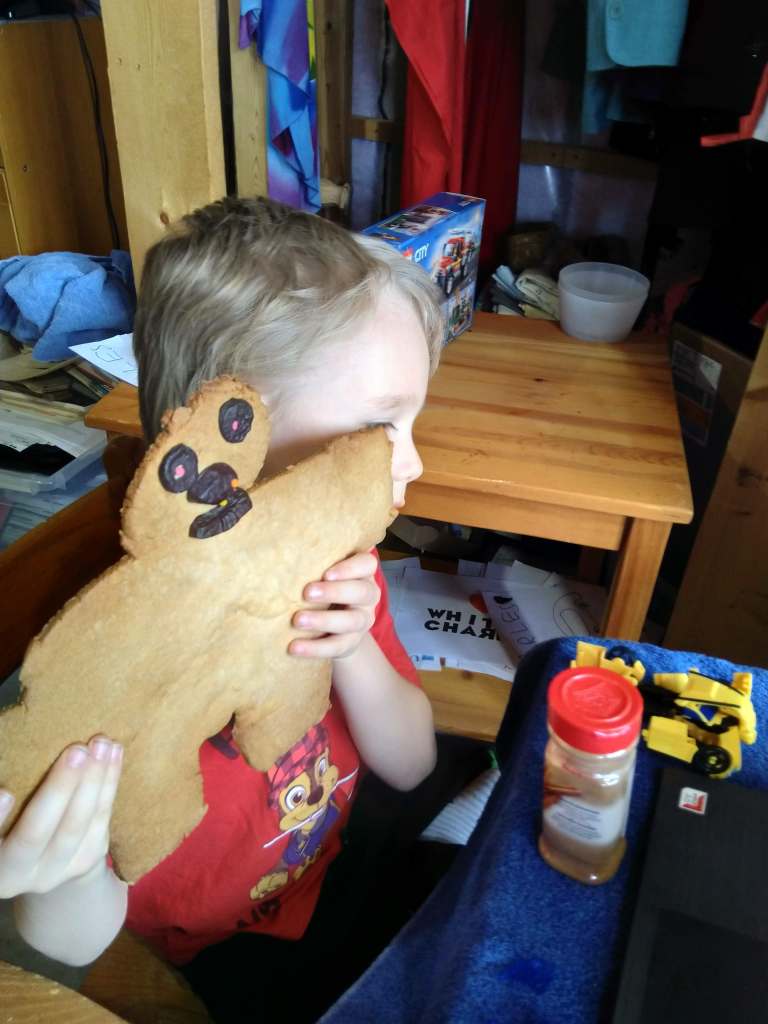
C awoke eager to make robot cookies this morning, so before we even arrived at school we had mixed sugar cookie dough, and cut out cookies to bake. C is getting very good at levelling cups of flour, though not so careful with the stirring yet. He is also very ambitious with his cookie cutting, creating a robot that was a huge challenge to transfer to the baking sheet.

It took a bit of nagging to get him to log in, and he initially refused to put up his name card for attendance.  We did hear the teacher say hello to him, so we know that they saw him.  However, as we moved into the morning’s physical activity he turned both camera and microphone off. They then asked them to put up their name cards again, so he turned his camera on and chose yesterday’s card to reuse, because it was “Bumblebee in Disguise” (which he continued to sing throughout the attendance process.)

The cookies were baking as we headed to class, so he was able to share his first “man”, and then eat it as the teachers struggled to get today’s art gallery presentation to show. We could hear the presentation in the background, as one teacher coached the others to “share this tab”, and it wasn’t working. They finally decided that the other teacher should give it a try. When it finally worked, we could see the presentation, and the audio was “jittery”, but at least they could see it!

C had eaten his entire cookie, and was enjoying a juice box.  Not the healthiest breakfast (he had a yogourt before we baked), but at least he was smiling.  

He was able to identify that the image was a sculpture, but did not attend to the questions as the image remained on the screen for several minutes. When the response to one of her questions was that it looked like a “god” she then asked what they saw that made it look holy.  I know that C had no idea what she was talking about. The focus today was on art from Africa and the diaspora, and the curator talked about the Yoruba culture. She connected it to farming, but did not situate her work with a map, nor with any text, and she did not mention Nigeria at all. At 10 minutes we were still looking at the single image of the mask, and there had been no other visual support for what she was presenting. C was now using the straw from his juice box to blow bubbles of apple juice across his desk. We persisted, since it had been the art gallery presentation on Tuesday that had inspired C to draw. At 14 minutes it was still the picture of the mask, and she was talking about its size.  Without any reference within the picture, I’m sure our kids had no idea how large it was. At 16 minutes the image changed to “Wellness Activity” text, white on black, while she talked about festivals, and asked them to think about a festival that they had gone to. There were other classes contributing to her Q&A chat, so she repeated some of the names…. but it still said “Wellness Activity” on the screen.  I wonder if early readers were puzzled by this. From what the curator was saying, I’m pretty sure that it was the teachers participating, not any students directly in the chat. At 19 minutes she shared a contemporary sculpture made from shoes, which C saw as a robot, though it was entitled “Mother and Child” (which was confirmed in the descriptive text next to the image.) By this time C’s juice box had been compressed, and was being used as the target for his wrecking ball fist. At 25 minutes it was clear that several students were struggling, with one being reminded to stop playing with her microphone, and to keep it off.

Had this been a presentation in one of my secondary school classes, I would have suggested more visuals, supportive text for key ideas, and a quicker pace than two images in 30 minutes.  It is clear that the art gallery staff are not trained teachers, and have not read “Learning for All“, or any of our curriculum documents (Kindergarten). 

At 30 minutes she shifted to “Mini art activity” on the screen, and described what she was doing, but never shared herself to show us what she was doing. When someone added to the chat that we couldn’t see, she finally stopped her screen share, and showed us her drawing for about one second. Seeing her face was very welcome, though the two bright pot lights either side of her face put her in shadow. And then it was over…. without any clear direction for the students to follow.

Back with the class they began their opening ceremonies, with a great deal of negotiation between the teachers. C was entirely disengaged by this time, playing with his transformer Bumblebee at the side. He refused to turn his camera off, which I did not challenge, as his activity might be useful feedback to his teachers. It was interesting today that C chose to try to read along with his classmate as she read the land acknowledgement. And then the teachers spoke about C being “up north” where there would be a different land acknowledgement. This is our homework for the weekend, to share at the next class.

They also asked C to stay online after the national anthem, to talk about the pictures that we posted earlier in the week.  The national anthem was only audio today, and the students were reminded at the end that they needed to stand and not play during it. C found the interaction with the teachers difficult, and he didn’t take turns well during the interaction. I think that talking about the activity from four days ago might have been one of the factors, as was the tiny image on the screen with the full grid of his classmates as distractions. And, of course, Bumblebee continued to be a draw for his attention. Looking at the screen, and seeing the empty rooms, tops of heads, and students obviously singing and talking, I’m not sure that anyone was truly listening.

The next activity (they had now been sitting still for 75 minutes), was a scavenger hunt, where they would be able to get up and move. I redirected C’s attention to the screen. The first task was to find something with the colour yellow, so guess what he held up to share? The teacher called on each student in turn. The teacher described what each student was holding, but C and I were only seeing their initials, not their faces, so it really wasn’t helpful to reinforce the concept of “yellow”. C was the last to be called on, and it took almost 15 minutes to get through this first cycle of the scavenger hunt. They were very attentive to ensure that they didn’t miss anyone.  The next was something that smelled nice, so he shared cinnamon and his robot cookie.  Next was something smaller than his hand, and so a piece of lego was his choice. When they asked for something with numbers, C immediately said “measuring tape”, and we had to go up two flights of stairs to get one for him. He was very excited to then make the tape go as high as he could.  The teachers continued to struggle with their layout, with one only seeing the initials, not their cameras. The next task was to find something in his favourite colour, and since he had his Lego firetruck beside him, and red is his favourite colour, that was his choice.  Today was “wear your favourite colour day”, so his T-shirt was also red. And next was “something that keeps you warm”, and he headed immediately for his blanket from his bed.  By now his desk was getting very cluttered with the cinnamon, firetruck, Bumblebee and cookie, so his blanket created a bit of a disaster! Then, find something that begins with the same letter as your first name. This one was a challenge for C, but he was able to find something that was also a good snack! The last one was something that starts with “B”, and so guess what he shared… again.

They had now been attending for 95 minutes without a break; longer than I would even ask of my grad students! And the teachers hadn’t had a break either, not even a few seconds off camera.

And then, finally, break time. They were invited to go and explore the virtual classroom (though this instruction was difficult to hear as C and his classmates all had their microphones on) for the asynchronous time.  They were also directed to a new Jamboard, but with the delays in Google Meet (seems to be a universal problem over the past couple of days), the teachers were finding it difficult to share to model the activity. The students were then invited to choose a sticky, and post a message to cheer up everyone else.  The teachers would like them to do it “on their own”, so we decided to try this later, when C might have more attention to give (than he had now, 100 minutes into this class, as he was “zapping” his Lego firetruck, and removing parts.) These directions took some time, so the break time remaining was only  48 minutes to eat and explore. I was surprised that C was unhappy that we were leaving the meeting, saying “I love my teachers”. I guess that observable behaviour doesn’t always align with how a child is feeling!


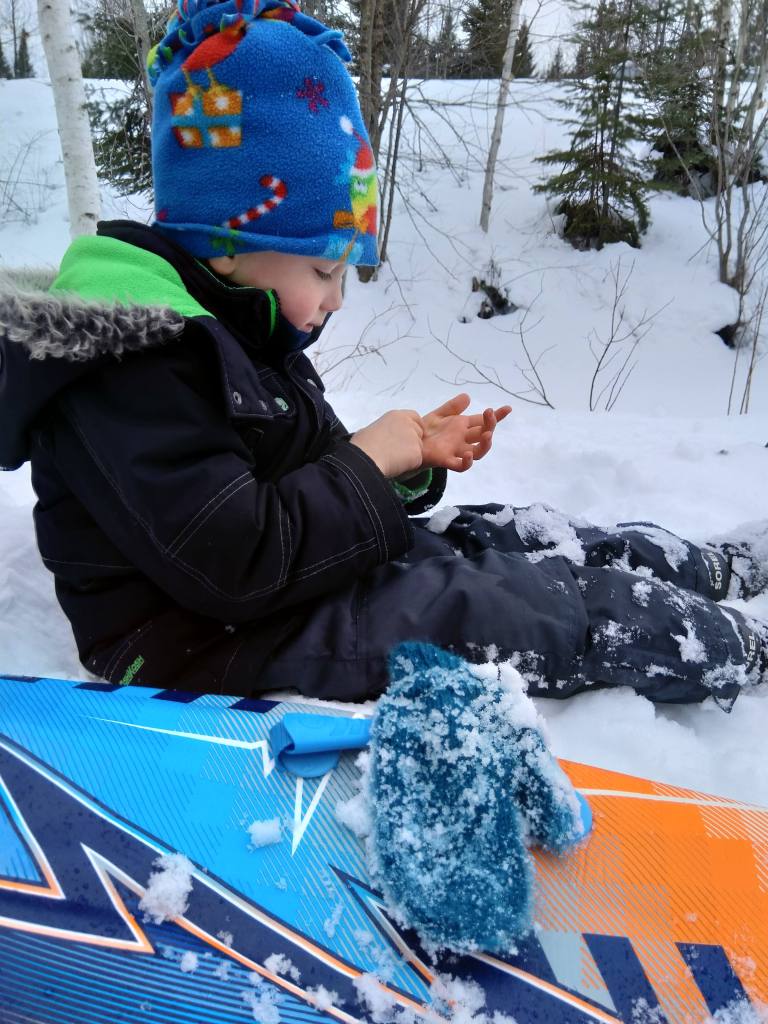
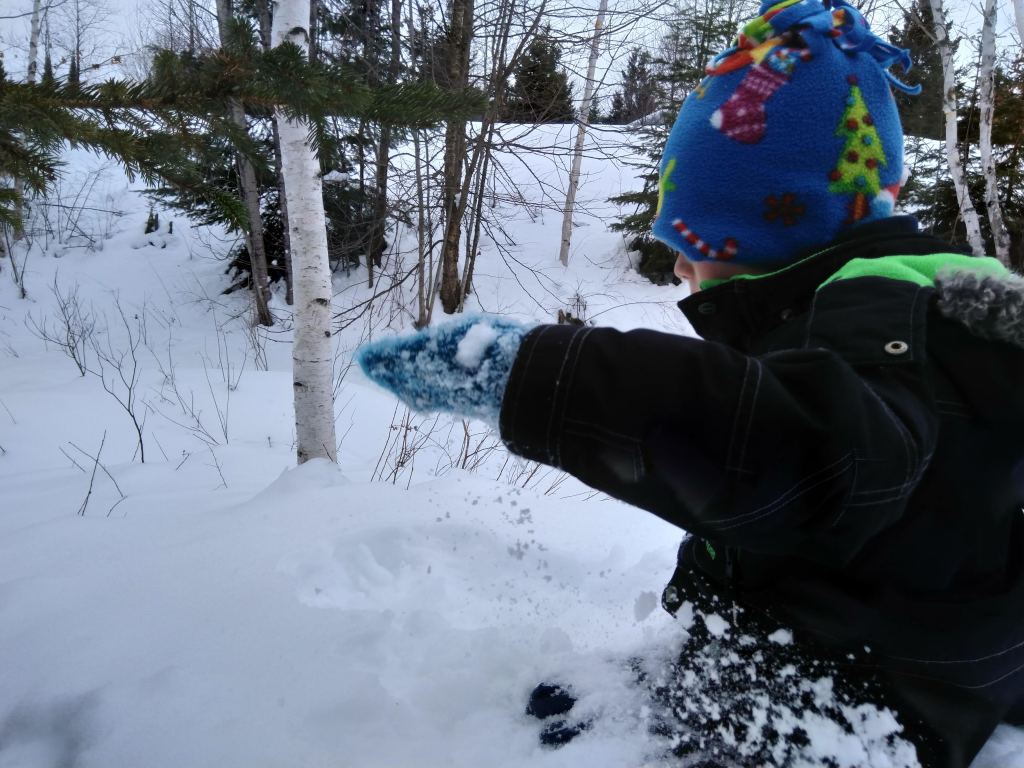
It was wonderful spending more than an hour outside. C chose to “earthquake” his igloo, built on Monday. Then we headed to the pond to slide down the hill and explore the characteristics of snow, bark, and “snow fleas”, more properly named “springtails”. The latter were found in our footprints from earlier this week, and likely came to the surface during our recent above-freezing days. There was plenty of singing of improvised songs, lots of kicking and digging, and even grandma got more exercise than usual.


Back  in the house we put all our wet clothes in the dryer, and C assisted me to begin sorting my quilting fabric.  He arranged my six boxes in rainbow order (identifying the last as indigo), and then rushed around to find other containers for black, white, rainbow, brown, pink and “uncategorizable” fabrics. Then we cooked Mac and Cheese, and C relaxed to watch “Justin Time” while he ate. This adventure show incorporates geography and history, and introduces C to new vocabulary that then shows up in his conversations with us.

I took some time to review the content from this week’s Google Classroom and the Virtual Classroom (Bitmoji).  As of 2:15 there was still nothing more in the Stream than the Jamboard that they shared this morning, so I was not sure when they would be reconvening for the end of day (I assume 3:00), nor what activity was planned.

Instead we visited the Jamboard, and read the messages already there from six of his classmates.  Then we decided to add an image, so he drew a happy face, sounded out and wrote the word “SMILE”, and added his name. Using the “image” function we were able to take a picture of his artwork and his own smiling face, and add it to the Jamboard. 

Then he returned watching more Justin Time, eating more Mac and Cheese, and gave me time to reflect on the day.


I am impressed that he stayed nearby for almost two hours of online activity. By not pushing him (except when he was asked to speak to the class about his igloo building) he seemed more willing to return occasionally, and engage in the activity. He was more connected during the Scavenger Hunt, less so when they were sharing, and not at all when there was nothing for him to do but listen.

I am wondering how much direct instruction would have taken place when he was attending in person with his JK/SK class. I suspect that it was much less than we experienced today. I also suspect that his teachers did much more 1:1 interaction; they are currently doing almost none. Maybe they could use their tools to have students interact directly with them individually for 5 or 10 minutes, a couple of times a week.  I think that building that relationship, checking in personally, and supporting turn-taking in conversation, would go a long way to supporting engagement when they are back in the full-class, online setting.

So, now it’s the weekend.  We’ll continue to do creative activities, get outside a lot, and enjoy video resources together. And I hope that C will be happy to return on Monday, to see the faces of all his friends, and begin to develop some self-regulation and participate more fully.

I wish his teachers a relaxing two days, and a fruitful Professional Learning day on Monday. I hope that they are inspired to consider planning for more activities that are chunked within shorter timeframes, and which allow for direct communication with each of the students. I’m sure that they end their days exhausted, and feeling that they haven’t really connected. I’ll continue to reflect too, and consider how I might help from home, to connect C to his teachers and his classmates.

Happy Friday!


Junior Kindergarten Online – Journal – Day 3

Day three began well, with C beginning a morning routine.  He has made a new name card each day, and this serves as a good warm-up, and fills the time until the Google Meet link shows up in their Google Classroom. By getting into the class as soon as possible he gets acknowledgement from his teacher, and seems willing to engage. Having snacks nearby has also been a help (thank you to one of my teacher-candidates for this suggestion!).

Today the routine of the land acknowledgement and national anthem was followed immediately by physical education. The teacher modelled the warmup, and then shared a “Let’s Exercise” video, with choices of movements that moved quickly and had upbeat music. She used half the screen for the video, and the other half was the class grid. C still needed prompts from me to return to the computer, and turn his camera on. The scavenger hunt to find an object beginning with “J” also required my assistance, but C correctly recognized that Jacob and Jonathan could have just found themselves. Of course, throughout this, he was heading to the bed to tumble and jump (obviously not ready to finish ). He was happier to participate when she asked them to do a movement that begins with the letter “J”. When he was frustrated at not being called on his teacher said “We hear you C”, and this went a long way to keeping him connected.

As they began to talk about what they liked about their movements, to give their teacher feedback, C chose to leave the class. We returned, so that we could hear what was going on, but shifted to another parallel activity of gluing down letters, which worked for only a few minutes.

The next activity was to review the slide created in a previous class, which listed what the class already knows about penguins, and what they wonder. The slide had a great deal of text, and only one image in the middle. For the non-readers there was little to assist our littles to focus their attention. C chose to put his fingers in his ears, and sing some of the music from the previous activity, and he was very angry when I attempted to redirect him.  There were some very sophisticated questions based on this version of a KWL chart, and the solution provided by the teacher was to look at a book. She shared the National Geographic Kids Library book from YouTube, turned down the volume, and read from the book. This was very effective once she found a page to pause at, but while it was running she found the words to be blurry. Her choice to just play the video resulted in echo, since some students still had their microphones on. C was interested in the illustration of an Emperor Penguin, but lost interest in the conversation and questioning, in favour of his almost-empty snacks. Because the teachers had been saying “keep your mic off”, even when he had an answer to one of the questions he refused to turn his mic on to contribute. The return to the book, with the echo, made the information difficult to understand, so we had a side conversation, which evoked some good responses from C. Is was unfortunate that the teachers identified polar bears as predators to penguins, since they don’t live together anywhere outside of zoos.

I wonder if the students could have been asked to watch the book independently, and then to participate in a more structured conversation?  This would have avoided the difficult transitions between reading and questioning, and would have permitted them to hear the text more clearly. At 75 minutes into the class, and more than 30 minutes in this single activity, C was now VERY restless, and so we chose to leave.


We sledded for a while, and then played in the hot tub. C identified the first and last sounds of the words he was using and was able to sound out the “Shark Patrol” on his swim shirt. He dressed himself, and then relaxed with a burger and a video game.


I have checked out the activities we missed, and those for this afternoon.  This morning’s activity requires that he write a note in Jamboard: definitely not within his abilities. This afternoon’s activity will be to make a sensory bottle, and requires a clear plastic bottle, oil, glitter and food colouring. If we had these materials I still would not allow him to gather them from the cupboards. How many homes stock glitter and food colouring? The request was posted at 12:10, for the 1:00 activity!

There is no agenda for the balance of the day, so no way to make any further decisions about whether to insist that he sit and join in to the Google Meet.

So, I think we’ll pass on the afternoon’s activities, in favour of some baking to take to his GG tomorrow.


The baking was great, and C even ate a couple of our almond flour and blueberry muffins!

I then decided to check out the Facebook group, supporting online learning for our board.  And I was blown away by the number of posts from parents of K-3 students, struggling to get their children to attend. They are very worried that they are losing crucial skills, and are justifiably concerned that their children are being turned off learning entirely.

So, tomorrow, I will wear my “how to make this better” lens again, and see if I can see ways in which I can work better with C, to keep him learning without “nagging”.

Have you found anything that works for you with your 4 to 9-year-olds?

Preparing our New Teachers

It’s mid-December, and I know that the Teacher Candidates who began our pre-service program imagined a very different reality than we know today. They were promised a program of teacher-preparation, with placements with Associate Teachers which would prepare them to enter classrooms upon graduation.

Instead, they’ve had to pivot their university courses from face-to-face, to Adobe Connect and Zoom. They’ve missed their second placement entirely, as it was to begin the day that lockdown began in March. And now they are in placements in secondary schools with teachers who have limited experience with Google Meet, PearDeck, Brightspace, and all the other tools of their new remote/hybrid/online classrooms.

It’s one thing to “train” for a job; and it’s another to figure out the job while doing it. Both our Associate Teachers and our Teacher Candidates are in the middle of a steep learning curve, and boy, are they learning!

Some boards have asked teachers to teach fully online.  This is the simplest model, and one which our Teacher Candidates have experienced during their third term as students.  They have developed a strong toolkit, and have had excellent models in their university professors, and so they’re doing a good job when they land in these classrooms. Their students, however, are novices with the technology, and so they’re having to teach both the course content, and the tools with which to learn.

Some students are in traditional classrooms, but the students are physically spaced, wearing masks, and attending in person for only some of the classes. These students also have synchronous online classes, as well as asynchronous assignments where they work from materials within their learning management system (LMS), such as Google Classroom or Brightspace. Building community, supporting social learning, and monitoring individual student progress is a new challenge.

Many students are in hybrid settings: the teacher has some students physically in the classroom, and the rest of the students online, both at the same time! This requires accessing two very different set of tools, and trying to deliver them simultaneously. Some of the students are able to provide real-time, valuable feedback throughout the lesson, and others are merely muted names on the screen.

The most challenging scenarios I’ve encountered are physical and health education classes, with as few as two or three students in person for a 2.5 hour block, with the rest of the class at home without equipment.  They signed up for “phys. ed.” and they’ve ended up having to do a lot more reading and writing than they anticipated.

This move to larger blocks of time was designed to minimize the overlap of cohorts within schools, but they have created learning sessions that are far longer than most teenagers can manage without distraction.  I hope that reflection on the part of school leadership might result in new models that permit facility-dependent programs such as physical education, nutrition, construction, etc. to bring more groups into the school to use the space, throughout the day. 

I’m hearing from my students that these learning teams of teachers are having to experiment, reflect, and problem-solve every day, to try to meet the needs of their students. Teachers are questioning the use of traditional assessment tools, and worrying that the challenges of slow internet, lack of access to technological tools, and limited support within their students’ homes might be roadblocks to their students’ learning. They are finding new ways of teaching and assessing, and I hope that they will soon begin to share their successes and support their colleagues to adopt these new strategies.

As I conference with my students, viewing them either live in Google Meet, or recorded in their classroom, I am hearing that they are working harder than they ever have.  And they are learning more than they could ever imagine.

We are graduating an amazing group of young teachers this December.

Coming soon to a classroom near you!

No Longer School Online

As our administrative oversight duties for our Online Secondary School have dwindled, I’ve begun to consider what might be our next challenge. It was exciting supporting teachers as they shifted to a fully-online model, but I am less excited about supporting them as they return to an adaptive or hybrid model in their home schools for Quadmester 2. So, I have chosen to conclude my duties, and reserve some of my remaining available work days for the next exciting challenge.

I am very proud of the online school that we have built, and of the teachers who have made it such a success. Here are some of the reasons why I think that this model has worked:

Online Teacher Networking

Our online teachers have been drawn from more than 30 different secondary schools and from our long-term occasional team of teachers. They have come together, most never having met each other, and have built course and department teams that have shared resources and supported this new model of instruction. As they return to their home schools, they will bring with them a rich toolkit and strong connections to their colleagues.

Online Student Agency

Our online students have been guaranteed that 25% of their program is self-regulated. They see their teachers for 3 full periods every two days, and have one period in which they work at their own pace utilizing materials from their LMS. This has provided them with some flexibility, while developing their self-regulation skills.

Online Consistency

The timetable for our online school has allowed for consistent sequencing and scaffolding, so that teachers who teach two classes of the same course can proceed with both in the same order. In the current adaptive model, teachers see one cohort in the first half of the week in person, teach synchronously in the afternoons, and then see the second half of the class in the second cohort in the last half of the week. This means that any hands-on activities are either conducted in advance of the theoretical lesson, or afterwards, but rarely will they encounter the cycle of theoretical and hands-on in the same order.

Our online teachers have been able to establish routines and norms and consistently reinforce them in each class. This creates a safe environment for learning, and minimizes frustration for both students and teachers.

Online Tools

Our online teachers have developed facility with either MS Teams or Google Meet, and with Brightspace/D2L or Google Classroom. They have added Padlet, Mentimeter, Pear Deck and Bitmoji classrooms, and experimented with other online tools to enhance their instruction and assessment. With these tools, students can easily access class materials while in class, and when completing homework tasks. They do not need to shift from digital to paper, nor from screens to in person.

Online Efficiency

Our online students can sleep in, and arrive in class on time in only minutes. And when they conclude their class, they can immediately move to their chosen activity. Those attending in person are spending time in transit, in sanitizing activities, and dealing with interruptions that come along with in-person group activities. Other than technological failures, interruptions to class flow are rare online.

Online Organization

Because course tools and materials are organized by the teacher, students who struggle with organization are better supported. There are no more crumpled papers at the bottom of backpacks!

Online Professional Learning

Our online teachers have risen to the challenge, shared best practices, and sought out new strategies. We enjoyed several teacher-led workshops, entitled “Log and Learn”, over the past two weeks. Their modelling of their classroom practices provided our teachers with inspiration. I was impressed by each teacher’s presence online, their strategies that enhanced their students’ engagement, and with their positive approach to online learning.

Online Student-Student Connection

Our online students benefit from teachers’ support of collaborative activities, through the use of breakout rooms, threaded discussions, and other digital tools. Because they know that their students may not know each other, they have added activities to support connection and building of community. And while the lesson is in progress, students can utilize Chat functions, or other back-channel tools, to connect with each other without distracting the entire class. No more side conversations, or passed notes!

Online Student-Teacher Connection

Within their digital environments students see their teachers’ faces and class materials clearly. Most of the time the teacher’s face, or the tools they are manipulating, are the sole focus on the screen. Their focus can also be directed by the teacher to others in the class as they contribute to the lesson. Chat serves to provide in-the-moment connection, and email is a necessary tool between classes.

Online Success

At midterm, we saw instances of high achievement in many classes. We questioned this, and challenged teachers to share their assessment data, and to explain how they determined midterm marks. They reported that they had students who were able to fully explain concepts, and make connections and apply their learning. They had triangulated their data, and it indicated that many students were achieving much greater success in this online environment than they had been in person.

Of course there were also the other extremes. Most of these were challenges of attendance and of technology, both of which are “fixable”. We need to know more about those who have not succeeded in this environment, and how we can better support them as they move back to a hybrid model.

I am very worried about this new hybrid model, and concerned that it will lose the benefits of the current F2F classes AND lose the benefits of the fully online model.

But I am hoping to be proven wrong!

School Online – Journal – Days 35 to 41

In my last post I wrote about “gradual release of responsibility”, and now it applies to me.

Last week was mark reporting, and so we were busy supporting teachers to enter marks, and ensuring that report cards were distributed via email to our students. Among our teachers are some with years of experience, alongside those who have never determined midterms marks. So it was a busy time, with many emails back and forth as we supported and educated.

We’ve now had three teacher-led workshops: each one providing our teachers with new tools to bring to their online classrooms. I am so appreciative of the efforts our teachers have made to share their expertise.

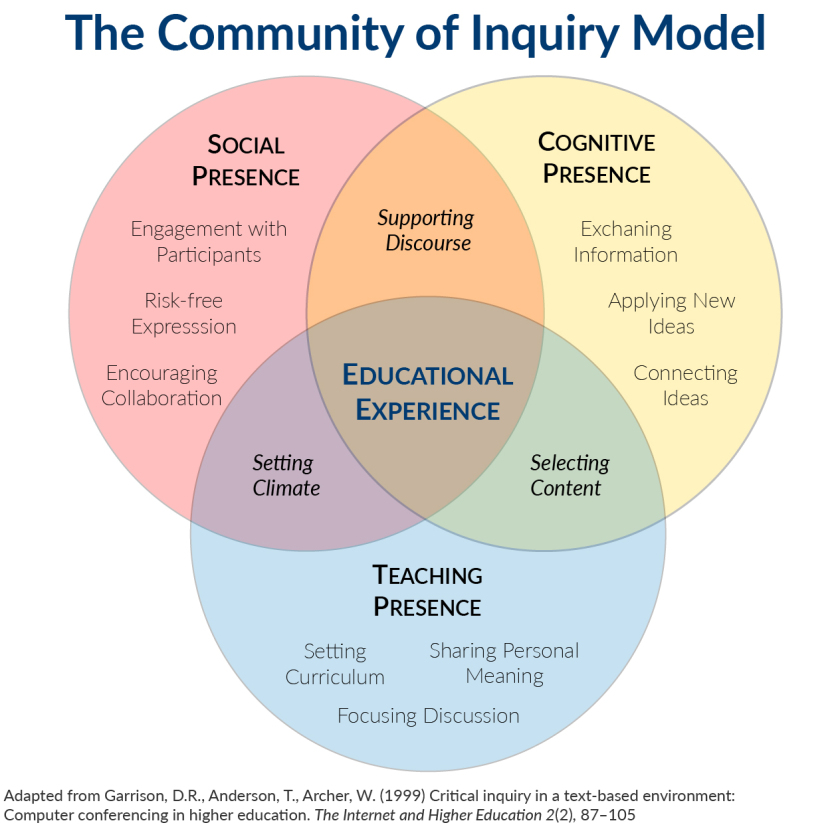
While not nearly as experienced, I’m going to be co-facilitating a workshop later this week, and again the following week, working with another instructor from Ontario Tech University to share best-practices in online secondary school instruction. Her work is based upon that of Garrison, Anderson & Archer (1999), which was developed in a text-based online environment, but applies equally well to our multi-media synchronous environment. We will be engaging with secondary school teachers, making connections between this theoretical framework (see illustration at top) and their daily work.

If you’re interested in this, or other workshops, please check out https://ote-shareconf.weebly.com/.  Each session is 90 minutes in length, facilitated by Ontario Tech University instructors and friends, and costs $10.00.

Back to the “release”.  My work has been “dwindling”, and I’m spending my time responding to emails that could easily be managed by others on our team.  I have no exciting challenges on the horizon, and so I am preparing to head on. There are those on our team who will be continuing to support our Coop program through a full semester, and to manage the shift of some of our most vulnerable students into the new model. But I am seeing myself without any agency to influence our program and processes in Quadmester Two, and I am feeling useless.  

Our online teachers will be bringing a huge toolkit back to their “brick and mortar” schools, having instructed synchronously 75% of the time, with strong asynchronous content for the remaining 25%.  They have worked entirely online, both with their students and with colleagues and admin.  They have juggled new tools, with little training or support.  And they have thrived.  One teacher told me that he didn’t know why so many of his students were doing so well in his class. He was triangulating his assessment data with conversations and observations, and they were still exceeding all expectations.  He said “What should I do?”. I said: “I guess you celebrate!”

With the new demands to teach to both the students in front of them in the classroom, and those online at the same time, they are facing new challenges.  If the hardware and connectivity work, I know they will succeed. The challenge to connect students in all three cohorts, and build community, will be a greater challenge than that of instructing. Teenagers crave connection, and they have been starved since March.  Bringing online tools and expertise to the F2F classroom should begin to address that need.

I wish our teachers well as as they embark on Quadmester Two in mid-November.  They have proven themselves, and should be proud.

School Online – Journal – Day 30

I started Day 30 with my usual trip through my Inbox, addressing questions from our teachers before the school day began.

Then our admin team met with one of our teacher leaders, who has been working with us to prepare for next week’s planned staff meeting. About 10 minutes into this meeting I was feeling overwhelmed by the task of taking a slide deck created by someone else, speaker notes that were becoming too dense to read easily, and a new-to-me medium of MS teams to meet with my designated group of teachers.  My suggestion that we create a live event, rather than multiple simultaneous sessions lead by each of us, was thankfully adopted.  It’s still going to be a new experience for us, but we can focus our efforts and communicate a single, consistent message to our school of more than 500 teachers. We will also have time to do a “dry run” on Tuesday, so that we might encounter fewer glitches for the real meeting on Wednesday.

When I made it back to my inbox, and my daily check of Facebook and Twitter, the conversation had grown around the rumoured changes to our instructional models. I spent some time in conversation on the phone with one teacher regarding her concerns about the possible switch from fully online into a hybrid model. I was, again, reminded of our teachers’ dedication to their students; this teacher has accommodations to work from home, and so is guaranteed to remain online.  Her worries are for our districts’ students and teachers.

A few weeks ago I challenged Jennifer Gonzalez (@cultofpedagogy), author of the Cult of Pedagogy blog and podcast, when she asked for suggestions to improve teaching online and in hybrid settings. I was looking for ways for teachers to improve the student-to-student networking and communication, prioritizing it over the transmission model from teacher to student. She rose to the challenge, and her blog, How to Teach When Everyone is Scattered is a gold-mine for teachers faced with what appears to be an impossible task. I met Jennifer when she was a keynote at our board’s summer conference for teachers several years ago.

I am not going to repeat her content here, but I will summarize her key points:

  1. Create Student Cohorts
  2. Limit the Synchronous
  3. Chunk the Time
  4. Build Community Intentionally
  5. Experiment with Cameras and Screens
  6. Optimize Discussions

And she concludes with advice that I wish I had written:  “Consider teaching in a post-COVID world to be the most massive project-in-Beta ever. It’s going to be messy, but that’s how humans learn and grow and adapt. Continue to experiment, fall apart on the days when it’s your turn (because everyone seems to need a turn every now and then), ask students and parents for feedback, observe other teachers when you can, and most importantly, keep giving yourself and your students grace.”

As we head into our Thanksgiving Long Weekend here in Canada, please give yourself grace. My grandmother was “Mary Grace”, my mother is “Bette Grace”, and my husband and I named our daughter “Emma Grace”, and its meaning has become stronger to me in the past eight months of this pandemic. Merriam-Webster provides 17 definitions of grace. In its biblical roots, grace refers to mercy and forgiveness.  In its more modern definition it may be used to mean ease and suppleness. 

I wish our teachers grace in all its forms.


Photo by Cleo Vermij on Unsplash

School Online – Journal – Day 26

Today we began week three of our online school, and the nature of my email inbox is shifting.

Student Attendance

Our teachers are now pursuing students who haven’t yet arrived.  We ask them to reach out to parents first, then guidance counsellors, and finally to connect with the VP responsible for then student (as determined by their surname). To accomplish the first, the teacher must have access to our student information system, and know how to query it to locate each student’s record. So I spent time today sharing the documentation on our system, and then troubleshooting access to the documentation and/or steps within our information system. Then I shared again how teachers could find the name of the guidance counsellor, and the list of alpha VPs. With some teachers only now gaining access to our information systems, it’s a jagged front, and each query requires an individualized response.

We now have office staff who can assist with corrections to student attendance, and with verification of students who could not be verified by their teachers.  I am not sharing the names of our staff broadly, as I do not know the impact on them of what is essentially a school that is an order of magnitude larger than any other school in our board. I will play “gatekeeper” until we figure out how they will be able to handle the deluge.

Teacher Absences

The past week has been spent letting teachers know how to apply for approval of absences such as holy days or family responsibility.  Although they are still attached to their home schools, we must do the approvals.  And we need to ensure that they enter the absence into another system, and that they do NOT request a supply teacher for the first few days of absence.

Communication

Although we have divided our students into groups by surname, and our teachers into groups by subject area, there are still hundreds of questions each day for each of our teams.  And the master list of “who does what” has traveled down in everyone’s inbox, and needs to be sent again to most who need it.

Professional Learning

Having shared the student information system documentation, I then received a beautiful email from a teacher, offering to provide a workshop for our new teachers.  I know that if I offered a workshop many teachers would see it as a “demand”. And I don’t want to pressure any of them, as they plan assessments in order to have data for next week’s report cards. So this teacher has offered to communicate directly with her colleagues, and I am hopeful that some will accept her offer, and learn the skills they need to work efficiently and effectively with our system.

Technology

While I pride myself on my facility with computer technology, I really don’t have much experience with the tools our teachers need to use.  And as an administrator, I can’t even try some of them out! I really am going to have to practice with both Google Meet and MS Teams, as this seems to be the area of least experience for our teachers as well.  Wish me luck!

Teacher Education

I accepted this role as a half-time Principal, but haven’t yet had a half day.  I teach a couple of classes in the Faculty of Education at Ontario Tech University, and this morning I managed to listen to our guest speaker (an elder, visiting and explaining the Seven Grandfather Teachings: Love, Respect, Bravery, Truth, Honesty, Humility, and Wisdom) while screening board emails. 

When my class met, following this amazing presentation, I had opened the wrong virtual classroom, and only nine made it there.  We figured out my error, emailed the rest, and they finally all arrived.  Then they informed me via chat that I had not enabled their microphones, and a little later that their cameras were also not enabled.  Thank goodness I have been working with them for a full year, and they are giving me the benefit of the doubt as things do not go smoothly. I comfort myself that I am modelling flexibility and a positive response to failure!

They are very anxious about completing the necessary practicum hours to graduate in December.  I have offered to connect them with teachers in our school who might appreciate their support in planning, creation of course materials, and in developing new skills within their asynchronous and synchronous tools. They can log hours as volunteers, without having to complete the paperwork necessary for a full placement.

Time Management

I am priding myself on getting my inbox to zero by the end of the school day.  I scan for emergency emails to ensure I don’t leave anyone hanging for too long, and it’s a positive sign that I managed to avoid working throughout most of the weekend. I know that our teachers will likely find time to reach out to me in the evenings, not during the school day, so I return to email a couple of times each evening, to respond to issues that will impact teachers and students the next day.

I wonder if our families realize how close to 24/7 the job of a teacher has become?

School Online – Journal – Day 25

Day 25 was Friday, and Monday is World Teachers’ Day, so I have waited until Sunday to post this blog.  I have been recognizing World Teachers’ Day in many ways over the past couple of decades, but this year has me stymied.

How do we recognize how challenging this past year has been for our teachers? How their relationships with their classes were challenged when they pivoted to Emergency Distance Learning in March? How they rose to the challenge, keeping their students connected and learning? How they worked with their schools to bring computer hardware, connectivity, and support to families? How they had to learn an entirely new skillset, in order to continue as teachers?

In one of my previous roles I was responsible for supporting the use of Instructional Technology in our school district. When we considered the possible use of LCD projectors in classrooms we planned a 5-year process of pilots, assessments, and then staged implementation.  But this past March we compressed that entire process into a couple of weeks, and implemented across the entire system an entirely new means of instruction.  It wasn’t just the hardware that changed, but everything we know about F2F instruction had to be modified and augmented to meet the needs of our new reality.

Taking attendance? How to you record that a student was late because their Internet connection dropped? What if a student doesn’t actually own a webcam, and you’re only able to hear their voice? What if they have to share a computer, and so they might have to log in, find out what to work on, and then hand back the computer to let Mom or Dad attend a crucial meeting at their work?

Access to resources, while richer due to the Internet, is limited by copyright.  All those textbooks are still sitting on the shelves in classrooms, inaccessible by students.  Copyright laws permit reproduction of up to 10% of a text, or a single chapter, so teachers are having to choose carefully which resources they may use with their classes. Teachers are doing their best to share, but all resources require editing and clear presentation, in order to match the reading level needs of their students.

Interaction is limited by the platform.  While Zoom has been most prominent in the news, it is not permitted for use in our classes.  Instead teachers are having to learn how to function with MS Teams and Google Meet, both of which are structured for large group meetings, not group or independent work. Cooperative and collaborative learning is a challenge within a tool that is structured more for a single meet chair or instructor, with the rest of the participants limited to the use of “chat” to interact.

Organization of class materials requires significant writing and uploading on the part of our teachers.  In the past one might write on the blackboard or overhead projector, or prepare a PowerPoint presentation.. Now there must be a file uploaded, and in most cases it needs to be in a PDF format, requiring additional steps. While video has become a key component in our F2F classrooms, teachers are now limited by bandwidth, knowing that many of their students won’t be able to stream without lagging.

And building community has been a challenge.  Much of the time our students have their webcams and microphones off, so when we speak it is into a “void” of silence.  No nodding heads. No excited chatter.  And creating opportunities for students to interact with each other is a complex and time-consuming activity. 

And added to this is the anxiety related to the safety of our students.  We can no longer listen for signs of bullying.  We can’t see if our students appear tired or stressed. We can’t whisper in their ear, and ask if they are “OK”.

Despite all of this, our teachers are doing an amazing job.  They are juggling the demands of curriculum against the need to support the mental health of their students. They are working in isolation, and then reaching out to support each other through subject- and course-based networks. Social media is connecting teachers, and shared drives are allowing them to divide up the work, and reduce their load.

I am excited to hear what our teachers have learned through this process.  Will they adopt a hybrid approach, integrating more media and technology tools into their teaching? Will they choose to work online, having developed strong skills that support learning by students who need to work remotely? Will our models of “school” finally shift from desks in rows?

Tomorrow, please take a moment to recognize the extraordinary efforts of our teachers over the past seven months. And please continue to support them as we face the challenges of the months ahead.

Happy World Teachers’ Day!

School Online – Journal – Day 23

“Terry sends a lot of emails, so I am including her on this too.” This was my chuckle this morning, as I was copied on an email to one of our admin teams. 

Emails, MS Teams meetings, and SIS (Student Information System) queries are my life. And again I am thanking my grade 9 typing teacher (and grade 10 math teacher) Dale Watson, from Kincardine DHS, for helping me develop such strong skills. I just counted (as of 5:00 today), and today I composed and sent 110 emails; some in response to those I received, and a few that I sent proactively. So, it’s been a lighter day than many in the past two weeks.

We discovered that we hadn’t included Computer Science in our organizational plans.  Some schools group it with Tech, some with Business, and some with Math.  The course code begins with “I”, and there are only a few codes, so it’s easy to miss.  I think it’ll end up with us, in MST, but I am awaiting word from our Coordinating Principal before I reach out to include these teachers as well.

Our biggest roadblock now is the processing of paperwork in HR, and then the subsequent provision of rights through our various information systems. Managing our online school is new to everyone, and we are hiring so many people, it’s not surprising that it is taking time.

However our teachers are being very creative, and making it work despite delayed access to all the tools they need. We have a couple of people who are struggling and may not stick with it. But 99% are learning and growing.

I really need a break from the keyboard, as I have an online event tonight that I am excited to join. LearningForwardOntario is hosting a series of conversations with five amazing educators. It’s a sold-out event, presented online after the April event was cancelled.

So, I’m going to pull together a meal, and then sit down (again) at my computer to learn!


School Online – Journal – Day 17

The calm of the morning in Sunny Slope

Finally, a day when I managed to get to the end of my inbox, and step away for a moment or two! I am hoping that this means that our teachers are settling in as well.

There is still confusion about our timetable, from both teachers and students. And our system doesn’t allow for two attendance entries on the same day, so the period 2 classes who meet again in period 4 are not tracked accurately.  The period 1 classes are working asynchronously in period 3, so we don’t record attendance then.

We are slowly matching up teachers on leave with their long-term occasional replacements, although the transfer of online LMS components is much slower.  And there are still a number of teachers to be hired, so interviews will be conducted tomorrow.

Our community school guidance counsellors don’t have the ability to manage our waitlists, so that’s a challenge that will have to addressed soon, in order to get students into the last available seats in our very full classes.

But I am hearing as many successes as failures today.  Hurrah!

Let’s see if I am as successful tomorrow when I will be teaching two classes back to back for two hours each, with only a 10-minute break.  My classes are large: 37 in one, 38 in the other.  And so I’m giving them lots of time to work in smaller groups, sharing information in a Google Slides stack.  The first group I met last week, and the second are a new group to me as their instructor was asked to take on another class. So they will have missed our icebreaker, community-building activity.  I wonder how this will make a difference in how we work together.

One of my university students went to the other section of our course on Monday, and stayed. And now she wants to be excused from our class tomorrow.  While it makes some sense, with only nine classes and lots of group work, she really needs to be with our group.  It was tough to say “no” to her.

Tomorrow is a Day 2 for our secondary school, and we’ll see how many teachers and students end up together in the correct space when our periods 1 and 2 flip.  I really hope that everyone is re-reading their Staff Handbook, and reminding their students of the schedule.  It’s not quite the same as standing in the hallway, waiting for your class to arrive.  If you’re in Google Meet, or MS Teams, and no one shows up……..

I think it’s going to take teachers some time to get used to the sequence of classes: Synchronous, Synchronous, Synchronous, Asynchronous in a repeating pattern over two days.  Once they get in the rhythm, I think it’s going to work well.  Having a “work period” is a common practice in F2F classrooms, and this builds it into the cycle.

I’ll be interested to hear how our teachers are feeling in a week or two!  Let me know how you are doing, in a reply to this post.