School Online – Journal – Day 7

Isn’t technology fun? Maybe, or maybe not.

Here are some snippets from my Friday:

Welcoming new pre-service teachers to Ontario Tech University

  • Adobe Connect was new to them.
  • Several didn’t have earbuds or headphones, and so any audio from their speaker went back out their mic, creating a disconcerting echo. I’m hoping that they’ll have them on when classes start next week.
  • With almost 30 students, our thumbnail faces were literally “thumbnail” size.
  • This was the FIRST orientation activity where they were actually asked to speak to each other.  All previous had been webinars…. three days’ worth!
  • Result?  We had a great time getting to know each other.

Picking up a new laptop

  • I had to sign in and out at the board office.
  • I had to wait to be escorted, rather than heading to my meeting.
  • There were two of us in a huge room, both of us masked.
  • We were almost finished when I mentioned that I would be in a school next week, and found out that they then needed to add more to the setup so that I would be able to access Wifi.
  • Result? It works well…. except that you must be on the Internet to use many of the new tools.

Internet

  • As mentioned in a previous post, our ISP “up north” has disappeared.  And they billed me twice for last month, so I’m out a rather large sum of money.
  • So, when I made the trip up the 400, it was to a place with no connectivity.
  • Thank goodness for my personal phone and its data plan: I was able to tether to download, and send email.
  • Result? Headed in to town today, signed a contract with the ONLY LTE provider, and am now back online.

Data Tools

  • I was able to download the results of the Google Form survey of our online teachers, and bring it into Excel.
  • We made the survey simple for the teachers, but that made the data much more complex.  For example, when asked what courses teachers were assigned this year, some replied with course codes, and others with text descriptions.  And we asked one question, but received up to 8 data points.
  • I created columns for each subject, and then hand-entered the first letter of the subject (M for Math, E for English), as well as a few more specific codes.  What is the logic of having GLE as a special education course, and GLC as careers?
  • Once each record was coded, I was able to sort.  I then created a new worksheet for each subject area, and copied the teacher information to the new worksheet. 
  • Within each worksheet we may need to create more columns, in order to sort by specific course codes.  However, for many subject areas it may be sufficient merely to scan to pick out who wants to teach BOH4M0 or BTA3O0.

Timetabling

  • The building of the timetable is ongoing, and a gargantuan task with more than 9000 students and about 400 teachers.
  • Most of our most experienced timetabling Vice Principals are either retired, or have been promoted to Principal.
  • So, my contribution next week will be to fill in for one of the latter, who will join our School Online team in order to ensure we timetables for classes to begin next Wednesday.

It’s the weekend.  I finally have Internet again, and am capturing yesterday’s experiences before they disappear.  I’m looking for clothes to wear next week. It’s been six months since I wore my “Principal” costume, so I’ll have to dig.

On Monday I’m looking forward to experiencing our new hybrid secondary school model, where 50% of our students will attend for the morning, and then return home for both asynchronous and synchronous learning.  I’m going to learn all about PPE and distancing with teenagers!  And I would imagine that my afternoon will be spent trouble-shooting with our teachers who will be teaching synchronously for the first time from their classrooms, after working from home in the spring.

Because I also teach, in the morning I’ll be meeting my pre-service teachers, with whom I worked throughout the 2019-2020 school year, but this time it will be in Adobe Connect rather than at Ontario Tech University. I’ll be behind closed doors in the “Principal’s Office”, and if I’m interrupted by school staff it will just be a learning opportunity for my students.

I hope everyone is taking time for themselves this weekend, and doing something that relaxes and refreshes.  There are going to be a lot of new experiences next week for our students, for our F2F teachers, and for our Online School teachers.  I’ll be listening, observing, and learning along with all of you! I’ll let you know what learned in my next blog post.

Photo credit: Hans-peter-gauster-252751-unsplash.jpg

School Online – Journal – Day 6

Well it’s almost bed time for me, and I’m having to think hard to remember what my day looked like today. It started out slow, and then ended like a freight train!

As I mentioned earlier, our teachers don’t yet know what they will be teaching next week. So, a survey was designed to be sent out to our more than 400 secondary teachers, to request their input as we begin to assign teachers to classes.

Since we are a new school there are no distribution lists. So, I hand-keyed all the names, and hoped that our Outlook email system would find them accurately.  It did, for the most part, but there remain about 20 teachers whose names on our list don’t quite match their email names, and so they won’t have received the request to complete the survey.

It took me a couple of hours to copy and paste both the subject line and body text, and then to BCC each person. When it was done I breathed a sign of relief…. until I received the “gentle” email pointing out that I had identified this year as 2020-2012!  I must have copied that at least  10 times without noticing.

All I could do was laugh!

The survey will be due at the end of the day tomorrow, and then I’ll work with the resulting spreadsheet to create lists for each of the courses we offer, so that we can do our best to match requests to available classes.

That matching will take place on Saturday (no choice but to work the weekend), so that we can get the information out to teachers.  Fortunately the plan is to begin teaching on Wednesday, so they’ll have a bit of breathing space at the beginning of the week to plan, and to reach out to their students.

In my last post I talked about the challenges I anticipate. The one that is preoccupying me is how we create community for our teachers, so that they don’t feel isolated as they embark on a full year of distance learning.

I find that I do my best thinking in the middle of the night. So, it’s off to bed.

I hope your “school start” is going well, or at least as well as it can in these unique times.

School Online – Journal – Day 5

Day 5 for both our “bricks and mortar” schools, and our new Online School!

In person, our teachers are welcoming Cohort B of Grade 9 students, combining COVID training with our traditional welcome to secondary school. I can’t imagine what it’s like for our teens, heading off to “high school” in such a time.

Online, we are still awaiting creation of our timetable for almost 9000 students.  Did you know that software developers have never considered this eventuality? So, there have had to be a lot of last-minute software tweaks, and many tasks have had to be “redone”.

Since we have no solid timetable, we haven’t yet been able to assign our teachers, so they are out there in limbo.  As an administrative team we are working to define our jobs.  We need to support our students and our staff, and ensure that the needs are met by a team of Principals and Vice Principals, some of whom are working part-time.

So what are the roles of Principal and Vice Principal? We are thinking that the Vice Principals might take responsibility for a group of students, probably according to the placement of their last name in the alphabet.  Our Principals primary work could be to support teachers and liaise with parents.  So they may be grouped according to subject areas, in order to create smaller communities.

However, some of these departments will be very large.  We estimate courses for students in a year to be 7.5. and teachers each lead 6 classes of anywhere from 22 to 31 students. So our 9000 students will require somewhere between 450 and 550 teachers. Tomorrow night is the deadline for students to opt to join our Online School, so our number of teachers may grow as well. For English alone we are looking at 50 to 60 teachers.

It is hoped that teachers will know their assignments as of the weekend, and will have Monday and Tuesday to prepare before classes formally begin on Wednesday. But since this is still a tentative plan, the communication is awaiting confirmation, and our teachers’ anxiety is growing.

My role as a Principal will be to allay their fears, find out what my teachers require, and figure out how to get it to them as soon as possible.  They will be learning to use an LMS (Learning Management System), refine their use of Google Meet or Microsoft Teams, collaborate with others who are teaching the same course (many of whom they will never have met), and then connect with their students (whose anxiety is likely similar, as they sit at home!)

Since we still have two more days this week, and there may not be much news, I’ll take the next couple of blog posts to consider how I might support my teachers and students, beginning next week.

How will I build community with my teachers?

How will I support teachers to utilize research-based, student-focused instruction and assessment strategies?

How will I support the Mental Health of my teachers, and their students?

More questions than answers right now!

School Online – Journal – Day 4

After the long weekend, we teachers expect to head back to school, meet our students, and embark on the new school year with excitement and optimism.

This year is different.

Teachers in “bricks and mortar” schools in our district are spending this week orienting students to the new reality of COVID-19. Today they welcome Cohort A of the grade 9’s, and tomorrow it will be Cohort B of grade 9.  Thursday and Friday will Cohorts A and then B of grades 10, 11 and 12. They won’t be together as a class until next week, and then it will be the start of the “Quadmester” rather than “Semester”. Students will be enrolled in two courses, and they will be at school for two mornings, and working both asynchronously and synchronously at their computers at home for the rest of the time. So, teachers will be doing icebreakers and syllabus review for their four groups on Monday, but some will be F2F, some will be asynchronous, and some will be synchronous. No longer can they plan one “Day One” lesson.

But these aren’t even the School Online teachers. These are the teachers who are remaining in the “bricks and mortar” schools, to teach 83% of our secondary schools.

The School Online teachers don’t yet know what they will be teaching, have not yet been told who will be their administrators, and have received no training. They remain in their Home schools, doing primarily hallway supervision and directing the flow of students.  Not a very exciting or inspiring way to begin the school year!

So, today we meet as an admin team.  I am hoping that timetables have been built, and that teachers will soon learn their assignments.

Our “bricks and mortar” teachers can begin to plan their new repertoire of instruction, with some content provided F2F, some asynchronously, and some synchronously.  Since they have Cohort A and Cohort B of the same class, they are also going to need to duplicate the same content and activity in more than one mode, if they wish to follow the same scope and sequence. Or, they are going to have teach in lessons that do not have to follow a specific sequence, if they wish to use the same asynchronous content for both Cohorts. And since Wednesdays will be a “bonus” day for each of the four groups, as soon as we complete week 2 the groups will be out of synch. So many things to consider!

One of our district teachers has built a beautiful planning spreadsheet to help. Check out the twitter account of @miss_jtoor, and her Google Sheet at bit.ly/338150a. It’s wonderful to see teachers make sense of their new reality!

But our School Online teachers are in limbo, so their anxiety is growing. They don’t know what they are teaching. They don’t know who they will be teaching. They don’t know their schedule, beyond 8:30 to 2:30. And it is the first day of school!

Tomorrow I will share more details of both our hybrid “bricks and mortar” schools and our online school.

School Online – Journal – Day 3

It is still the traditional “week before school starts”, but this is one of those unusual years the occur once every six years where we need days before Labour Day in order to fit all of the school days between Labour Day and the end of June.

So today is Day 3 for our teachers, who are concluding all of the health and safety professional learning that is necessary to keep our students safe. It’s now mostly online, so many of them are completing it at home, and then heading into school to attempt to make their rooms safe. Many will be trying to achieve physical distancing that is mathematically impossible within their crowded classrooms.

So, perhaps those who have been declared excess to their schools, and who will soon learn that they will be joining our online school, will be relieved. I’m thinking a lot about how our new online school will be unique as we build it with teachers who were at the lowest on our seniority lists, and students whose parents fear for their safety in our “bricks and mortar” schools.

And it will be my job, as their Principal, to make it the best learning experience for students and teachers.

So, what did I learn on Day 3?

  1. When you are kicked out of your “class” you need a back-channel to let your teacher know. When I had to leave my Final Oral Examination (aka Defence), my advisor needed to reach me via cellphone to let me know to come back in. How will our students contact our teachers if their Internet goes down, or their device crashes?
  2. Sitting for 90 minutes in front of a camera is hard on the neck. Now, mind you, this was an exam. But for many of our students their interactions with their teachers feel like an exam. How can we support our students to sustain their attention, and remain physically healthy?
  3. When the class ends, so does the social connection. In a “bricks and mortar” school, the conversation continues as we head out of class, and out to the bus or car. That easing, and gentle shifting of focus, is important. How jarring will it be for our students to say goodbye, take off the headphones, and be back in their home world?

My online session ended with congratulations from my examining committee and a new title, “Dr. Whitmell”.

But the feeling when I closed my laptop, and took off my headphones, was a strong wish to be with people, not sitting alone in a room. I felt let both let down and frustrated, with excited and relieved. How will I, as one of our online school’s leaders, support my teachers and my students once our school day ends?

School Online – Journal – Day 2

Today’s Professional Learning began with my joining the staff of one of our “bricks and mortar” schools, working through a PowerPoint presentation in Zoom. With 100 staff in the room, and only about 20 with cameras on, it was an effective and somewhat relaxing way to begin the day. I thought a lot about how they might be feeling, connecting with their colleagues, but sitting at home.

They then headed out to do a training module that was not required of administrators, so I jumped into tomorrow’s package, and worked my way through a full-day’s-worth of PD over the next five hours. It was nicely put together, with several videos followed by reflections.

In between sections of the agenda I was checking my email (I now have six accounts I have to monitor between my grad program, school, pre-service teacher courses, and personal account) and getting set up for tomorrow.

Tomorrow I will be completing my PhD Final Oral Exam, via Zoom. I am at the end of five years of study, and very excited to have reached this milestone.

I’ll let you know how it turned out in tomorrow’s post…..

School Online – Journal – Day 1

September 1, 2020 was a day unlike any other since I began “school” at age 5 in 1965. While students remain at home, our teachers have begun the first of three Professional Learning Days. But, unlike other years where we have met prior to the Labour Day Weekend, this one began online.

We were all online, viewing a welcome message from our Director of Education. Then we completed COVID-19 training and WHMIS training, with choices of video, slide presentation, or text.

Those heading back to “bricks and mortar” schools were then permitted to attend a staff meeting… but only 50 at a time in a physically distanced space. Next week that all changes when our elementary colleagues welcome classes as large as 30 into very small classrooms! ….but I digress.

Our online teachers didn’t yet know that they are our teachers. They found out that they are “excessed” at the end of today, after they had already met with half the school staff, and then with their departments. And they know little beyond the fact that they will now be leaving their school as of Friday. We have 8200 students joining us, so you can imagine how many teachers headed home to share with family that all that they had planned for this fall has changed.

Those of us who do know that we are working online, along with those who are occasional teachers, then headed on for more online learning: Anaphylaxis, Concussion, and Asthma. The last two are provided by a central organization whose servers could not keep up. So I did that training before bed.

I am excited at the prospect of working with teachers to extend their skillset in this new online environment. I wish I could whisper “it’s going to fun” to each of the teachers who learned today that they are “excess”, so that they don’t spend their nights worrying.

And I’m excited that we will be working with new tools, in a new way, and will be learning together.

But, in the meantime we have to wait until timetables are built, teachers are assigned, and we figure out how we will work as a team to support them and their students.

So, I’m awake at night as well, imagining scenarios, and brainstorming ways to utilize our technology in service of learning, connection, and growth.

I’m hoping to document our journey in a series of blog posts: three this week, and then daily after the Labour Day Weekend. Please comment, or contact me directly, to add your perspective, or to ask any questions about the new path we are building for our students.

Learning Online – What works? What’s not working?

Over the past two months I have begun teaching online in two very different environments from the F2F classrooms I’ve experienced most of my career.

In one setting I am using an LMS (Learning Management System) called Canvas as the course organization, and teaching synchronously using Adobe Connect for two hours per week.  My students use the features of the LMS to access content, to discuss, and to submit assignments.  They also use the feature of Google for collaboration both in class (using Google Docs and Google Sheets) and with their classmates. We use email to communicate between classes, and occasionally we will connect via phone.

In the other setting I am using an LMS called D2L, and the entire course is asynchronous. The content, discussions, and assignment submission take place in this environment, and there is little collaborative work.

This latter version is what we in Ontario would be familiar with as the structure of the current e-learning environment for K-12, and which was proposed to be used for four of the 30 credits for our secondary school students, and which the unions lobbied to have removed.  The recent agreements have landed at two credits, but parents can opt their teens out of this, upon request.

The past two months may have changed the landscape significantly, as indicated by the Minister of Education’s direction to provide synchronous learning for students. (https://www.thestar.com/politics/provincial/2020/05/08/ontario-teachers-told-to-embrace-live-video-conferencing-as-school-shutdown-continues.html) His direction to do so takes place in the absence of any secure tools with which to do so, without allocation of any resources either in hardware or bandwidth to the teachers and students, and without research to support.

So, I have been thinking a great deal about how teaching and learning changes as we move through the various options of learning environment:  face-to-face traditional, synchronous supported with video technology, asynchronous supported with video technology, and asynchronous using an online learning management system.

1. Face-to-Face Traditional Classroom:

  • Real-time interaction
  • Student-teacher relationship is very strong
  • Responsive to student questions
  • Allows for collaboration among students in real-time
  • Efficient – teacher teaches once, and reaches all students in the room
  • Assessment is provided both in real-time, and scheduled.

2. Synchronous Supported with Video Technology:

  • Real-time interaction
  • Student-teacher relationship is strong
  • Responsive to student questions
  • Allows for collaboration among students in real-time
  • Efficient – teacher teaches once, and reaches all students in the room
  • Assessment is provided both in real-time, and scheduled.

3. Asynchronous Supported with Video Technology:

  • No real-time interaction
  • Student-teacher relationship is weak – students see teacher, but teacher does not see students
  • Not responsive to student questions
  • Does not allow for collaboration among students in real-time
  • Very Efficient – teacher teaches once, and reaches an infinite number of students
  • Assessment is scheduled.

4. Asynchronous using an LMS:

  • No real-time interaction
  • Student-teacher relationship is very weak – limited to text
  • Not responsive to student questions
  • Does not allow for collaboration among students in real-time
  • Very, very Efficient – teacher does not teach directly, but reaches an infinite number of students
  • Assessment is scheduled.

I am currently teaching, using options 2 and 4.  I love the synchronous teaching, but it is much more demanding than F2F in a traditional classroom, and some of my students are managing to “hide” by turning off their cameras and mics, so my relationship with them is more difficult to develop.

The asynchronous group is a mystery to me; I only know them from the assignments they submit. So, I’m thinking of adding aspect of #3 to my practice, to hopefully build more of a relationship, to more effectively “teach”, and to encourage them to connect.  I may even use some of #2, by scheduling “office hours”, and further connecting.

But, back to the Ontario context, in six weeks time the Ministry of Education has promised (https://news.ontario.ca/opo/en/2020/05/government-supports-online-learning-during-covid-19-outbreak.html_:

  1. Expanded core programming represents ‘traditional’ summer school courses focused on grades 9 to 12, with additional opportunities for grade 8 students to better prepare.
  2. Introduction of upgrading courses, which will allow students to upgrade their mark in a course in half the time it would have taken them previously.
  3. Targeted supports for vulnerable students to support access to non-credit ministry educational programs and leadership supports.
  4. Focused programming for students with special education or mental health needs, including dedicated learning supports such as access to educational assistants and existing after-school programs that could be delivered through summer school
  5. Communicating volunteer opportunities for students so that students can leverage virtual volunteer opportunities where possible;
  6. Summer programming in Provincial and Demonstration Schools to focus on continued learning for our students with specialized learning needs; and
  7. Key concept mapping for next year’s learning to focus on compulsory, high-demand and pre-requisite secondary courses

Promises #1, 2, 3, 4, and 5 require that students have the hardware, bandwidth, and supportive home environment to participate.

Promises #1 and 2 and well as possibly #4 require that content and a new learning environment be built, within which teachers will be teaching entirely new courses, and students will be participating using new tools.

And promise #7 is the death-knell for much of our rich programming at the secondary level, with may not be compulsory, in high demand, or a pre-requisite for post-secondary destinations.  I remind you that compulsory is: English in grades 9 to 12, Math in grades 9 to 11, Science in only grade 9 and 10, Geography in grade 9, History in grade 10, Careers and Civics in grade 10, French in grade 9, Physical and Health Education in grade 9 (let’s see what that looks like online!).  We only need to offer a Social Science course in grade 11 and three other senior courses to complete the mandatory compulsory 18 credits. If you add pre-requisite courses, you then need grade 11 and 12 courses in Biology, Chemistry and Physics, plus a fifth mathematics: Calculus in grade 12.

There will still need to be other courses to reach the total of 30, but those that are not “high demand” won’t be there. And these are the courses that keep our students in school: Physical and Health Education, Music, Drama, Visual Arts, Dance, Business, History, Social Science, Family Studies, and Technological Studies. Without these other twelve credits, our students will not qualify to graduate. So they cannot be ignored in favour of ONLY the compulsory or pre-requisite.

Back to the delivery of the program. We need to get as close to our #1, Face-to-Face in a classroom, as possible.  The best path is through option #2 – Synchronous Supported with Video Technology.

But, we need the technology.  It needs to be safe and accessible for all: teachers and students. And it needs to be flexible, to shift to asynchronous as well, since our teenagers may be caring for younger siblings, may have unreliable bandwidth, or may only be able to access the household computer at the end of the workday when their parent is finished their work.  Provision of hardware and unlimited internet access to both teachers and students is a necessary pre-requisite for success of this proposal.

Asynchronous with video technology also requires that teachers be recorded (as does synchronous in some cases) and this brings with it many privacy and security concerns. As a teacher I ensure that my background is unidentifiable, and I continually monitor my language so that someone can’t take advantage of my voice and “clip” it for their own entertainment, or for other purposes. However, I know that each class is now more risky than it has ever been, and with that comes stress and worry.

We are going to learn a great deal about teaching and learning as we look back on the past two months of asynchronous teaching and learning, and over the next year as we work through our transition in learning to this new online synchronous environment. I hope that we will eventually bring what we learn back to the classroom, and use it to enhance and enrich Ontario schools.  However, I fear that someone will choose the “quick and dirty” path, and hire a for-profit organization to deliver option #4 in order to make a quick buck.

Parents: please do your best to support us as we learn how to teach online. And then fight for us to return to the classroom when we are able, to provide the richness that our face-to-face classes provide for your children. A world without music, art, debates, collaborative inquiry, and strong social connections will be a much poorer one for our children.

My "Gradeless" Reading – Academic Journal Articles

I recently shared the books on my bookshelf that have inspired me on my exploration of a world without marks.

Here are some reflections on quotes from some of the journal articles that I have found most interesting:

“Educators have a moral imperative to dismantle the inequities that endure in our schools.” (p. 55)

Feldman, J. (2019). Beyond standards-based grading: Why equity must be part of grading reform. Kappan, 100(8). 52-55.

Educators are the closest to students, and so the inequities in the classroom are most apparent to them. Where they struggle is where their “moral imperative” runs up against the standards they have set for their practice, or have been set for them by the organizations that govern them. Educators find it difficult to compel their students to “follow the rules”, unless they are modeling that for them.  To dismantle the system, means NOT following the rules, but to follow the rules means preserving inequity.

“…increased use of grades for high-stakes decisions including student mobility, admission, selection, accountability, and reporting” (p. 18)

DeLuca, C., Braund, H., Valiquette, A., & Cheng, L. (2017). Grading policies and practices in Canada: A landscape study. Canadian Journal of Educational Administration and Policy, 184, 4-22.

Everyone wants an easy answer, and marks are the easy answer to the questions of university admission, job offers, and status. We need a way to validate achievement, without the use of numbers.  I believe that we have the technology, but we haven’t yet figured out how to use it.

“Distinguishing specific product criteria and reporting achievement grades based on these criteria allow teachers to offer a more precise description of students’ academic achievement and performance.” (p. 16)

Link, L.J., & Guskey, T.R. (2019). How traditional grading contributes to student inequalities and how to fix it. Curriculum in Context, WSASCD, Fall/Winter, 12-19.

Criteria, criteria, criteria.  Whether you agree with the criteria set in the curriculum, or not, it is much easier to communicate achievement when you have clear criteria.  Traditional grading, where points are given, ignores the precision of criteria, and does a poor job of describing a student’s achievement.

“…grading, like school calendars and group instruction, is part of the very fabric of formal schooling. As long as there is formal schooling, teachers will assign grades”. (p.21)

Anderson, L.W. (2018). A critique of grading: Policies, practices, and technical matters. Education Policy Analysis Archives, 26(49), 1-31. https//doi.org/10.14507/epaa.26.3814

The resignation in this statement makes me sad. Perhaps it’s the “formal schooling” that is the problem.  And perhaps our current COVID-19 crisis will be the impetus for us to abandon schooling, and get back to learning.

“Grading practices that have the potential to reduce failure, reduce dropouts, and improve school safety are, indeed, urgent”. (p. 71)

O’Connor, K., Jung, L.A., & Reeves, D. (2018). Gearing up for FAST grading and reporting: It’s time for schools to move toward a grading system that is fair, accurate, specific, and timely. Kappan, 99(8), 67-71.

I would go one more step.  We should get rid of grading practices, and go straight to feedback and validation of achievement of criteria. There is no need to reduce rich achievement data to a single number.

“Is my job to “rank,” to assess and sort students into disjoint bins depending on how they can perform the tricks I expect them to? Or is it to help them move forward in their lives better equipped to handle what will come their way?” (p. 870)

Karaali, G. (2018). On Grades and Instructor Identity: How Formative Assessment Saved me from a Midlife Crisis, Primus, 28(9), 848-874. https://doi.org/10.1080/10511970.2018.1456495

This rhetorical question summarizes where I am, hoping to “help them move forward in their lives better equipped to handle what will come there way”.

What have you read lately, that is inspiring you to change your practice?

My “Gradeless” Bookshelf

I’ve been hearing many requests for my list of books that inspired my research.  Here are some of the books I’ve been sharing with my teaching colleagues, to support them in their shift in assessment:

Rethinking Letter Grades

Caren Cameron and Kathleen Gregory (2014)

Rethinking Letter Grades Cover

This concise (64 pages!) book bridges assessment FOR learning to assessment OF learning, to guide teachers to determine a letter grade based upon evidence of learning that is linked to learning standards.

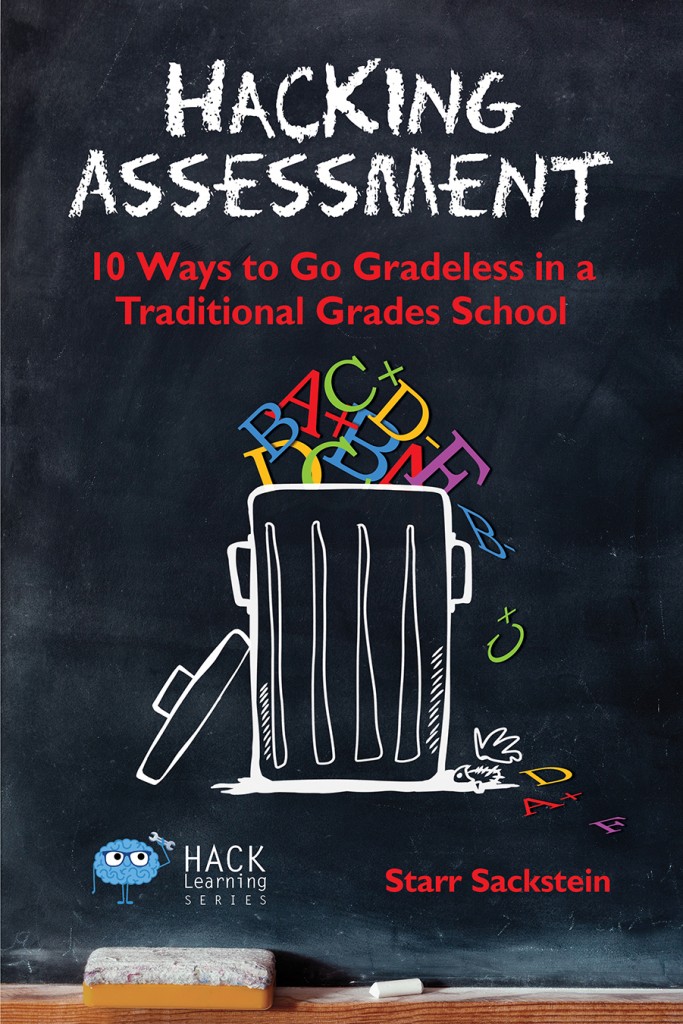
Hacking Assessment – 10 Ways to Go Gradeless In a Traditional Grades School

Starr Sackstein (2015)

The inspiration for many of my research subjects to make the move, these ten “hacks” include practical advice for teachers:

  1. Hacking-Assessment-eBook-cover-683x1024Shift the Grades Mindset – Start a no-grades classroom

  2. Promote Buy-In – Open lines of communication with stakeholders
  3. Rebrand Assignments as Learning Experiences – Design comprehensive projects for optimal growth
  4. Facilitate Student Partnerships – Work smarter, not harder
  5. Digitize Your Data – Ease data collection and inform learning with technology
  6. Maximize Time – Confer inside and outside of class
  7. Track Progress Transparently – Discard your traditional gradebook
  8. Teach Reflection – Help students become better learners with metacognition
  9. Teach Students to Self-Grade – Put the power of grading into students’ hands
  10. Cloud-Based Archives – Transition to portfolio assessment

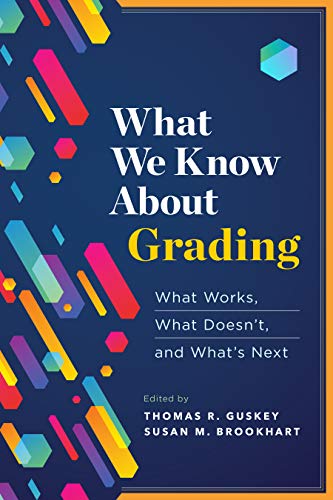
What we Know About Grading – What Works, What Doesn’t, and What’s Next

Thomas R. Guskey & Susan M. Brookhart (2019)

For teachers who can’t yet make the shift completely away from grades, this collection of essays reviews research, and supports teachers to:

What we know 2

              • Start with clear learning goals,
              • Focus on the feedback function of grades,
              • Limit the number of grade categories, and
              • Provide multiple grades that reflect product, process, and progress criteria.

Assessment 3.0 – Throw Out Your Grade Book and Inspire Learning

Mark Barnes (2015)

Challenge the barriers of policy, report cards, parental expectations, and tradition with Assessment Barnes coveran assessment process of SE2R: Summarize, Explain, Redirect and Resubmit:
  1. Summarize:  One or two sentences to describe what has been accomplished, and form the basis for narrative feedback.
  2. Explain: Connect evidence of learning to learning goals, targets, expectations or standards
  3. Redirect: Identify action necessary to meet learning goals.
  4. Resubmit: Cycle back to step #1.

Note:  This can be done by student, teacher or peers.

Visible Learning Feedback

John Hattie and Shirley Clarke (2019)

visible-learning-feedback-book-shirley-clarke-john-hattie-2018-250x353A key component of “going gradeless” is rich, descriptive feedback. This book examines the need for feedback to be aligned with the stages of the learning cycle:
                1. Surface knowledge
                2. Linking ideas
                3. Extending ideas

Grading for Equity – What It Is, Why It Matters, and How It Can Transform Schools and Classrooms

Joe Feldman (2019)grading for equity

And finally, the “WHY” of assessment reform: Equity. If you must use grades (as most policy currently demands), do it with practices that are mathematically accurate, value knowledge, support hope and a growth mindset, and empower our learners.