School Online – Journal – Day 8

Days 8, 9, 10, 11 and 12 will be spent in a real “bricks and mortar” school, filling in for a Principal who will be working to build our School Online timetable.  With more than 10000 students and more than 400 teachers, this is an unprecedented task.

That word “unprecedented” is on my list of the top word for 2020. It seems to apply to everything.

Today was the first day that I wore a mask continuously, from 7:30 to 4:30.  I am gaining an appreciation for my healthcare friends, and for the crocheted “ear savers” that I made last night.

In the school, today is the first day of classes, following a week of orientation. The first 150 minutes of day were scheduled as Period 1, Cohort A.  Students were met at a limited number of entrances to the school, applied hand sanitizer and ensured that they were suitably masked.  Most teachers were instructing up to 15 students, physically spaced, F2F. Some were also streaming their instruction to Cohort B, in order to keep both halves of the class in synch, rather than having them complete asynchronous work.

As teachers began their classes, I was in a Teams meeting with the Online School team, getting updates from the timetabling team, and discussing how we might define our roles as we move forward.  In the absence of department heads, we will be supporting subject-specific groups with a designated Principal or Vice Principal. Not sure if I will end up in the Arts, Technology, Math or Business.

Students departed at the end of their double-period class, returning home to resume work asynchronously online until the last period of the day, when they would meet their Period 2 class online.  Half of them will then continue with this group tomorrow morning, while the other half will have another online class before they actually attend class at school on Friday.  Our students will attend school two mornings per week, plus every other Wednesday morning for one of their two classes.

At lunch most teachers left to enjoy some fresh air, many “dining” in the parking lot. I am thinking that there might be many creative solutions appearing in the next couple of weeks, given that the other option is to eat alone in a classroom.

Then teachers returned to work, preparing asynchronous materials and setting up their LMS classrooms. In the final period of the day some were able to provide additional synchronous activities to their Period 2 class. The limiting factors appeared to be access to computers with webcams, few document cameras, and sometimes a quiet space to work. I think we’re going to need to post a message in the office during this period, reminding us not to call into classrooms or use the PA system, so as not to interrupt online teaching.

I managed a couple of circuits of the school’s hallways during the two afternoon periods.  With no students in the school, and teachers at computers either preparing of instructing, it was an eerie place.  I managed a few conversations, both with teachers I knew from past schools and those new to me.  They seem optimistic, and happy to be back with kids.

Our communication over the past couple of weeks has not used the term “hybrid”, but it seems to be an apt term to describe the teaching methods being used, with many more online tools than perhaps parents realize. Our teachers have a choice between Brightspace and Google Classroom for their LMS, and between MS Teams and Google Meet for their synchronous classes. They are experimenting, and learning, and will be experts very soon.

At the end of the day was the monthly staff meeting.  All teachers were in the school, but were meeting via MS Teams. With several interruptions where the network dropped the meeting, one VP lead the meeting, while the other monitored the chat and managed questions from those who raised their hands.  It was fairly effective, with some use of chat for clarification. As supply Principal I was able to listen, and hear the excellent responses from the Vice Principals to the teachers’ concerns.

Tonight I am getting prepared for tomorrow by reading the emails I didn’t get to during the day, writing this daily journal, and crocheting more “ear savers” to bring to school tomorrow. I’m looking forward to spending more time in the halls this week, and peeking into classrooms to see how our physically distanced classes are working.  I’m sure that by Friday my musings tonight will be replaced by new perceptions, and I look forward to this process.

12 Gradeless Models

In 2019 I interviewed 28 Ontario secondary school educators who are moving away from marks.

They all grounded their assessment practices in clear communication of learning expectations in the form of task lists, curriculum expectations, or overarching learning goals. They communicated achievement of these expectations through the use of hidden mark, traditional four-point rubrics, single-point rubrics, or descriptive feedback. The combination of these three types of communication of expectations and four modes of communication of achievement can be expressed as 12 models of gradeless assessment, of which 10 were utilized by the teachers interviewed:

Screen Shot 2020-09-12 at 1.52.08 PM

Gradeless Model 1: Tasks and Marks

  • Marks are assigned based upon number of steps or concepts, which are added together to calculate a final mark.
  • Feedback is assumed by number of points or marks given by teacher.
  • Marks may be shared with students, or maybe hidden or deferred.

While gradeless model 1 includes marks, the two interviewees using this model expressed their belief that it qualified as “gradeless” when they hid or deferred sharing of marks until the end of the learning cycle.

Gradeless Model 2: Curriculum Expectations and Marks

  • Assessments are coded by course expectations which are then weighted to calculate a final mark.
  • Feedback is assumed to explicit links to course expectations.
  • Marks may be shared with students, or may be hidden or deferred.

As with gradeless model 1, this model was felt to qualify as “gradeless” when the marks were deferred or hidden. Gradeless model 2 was valued for its strong connection to the curriculum, and promotion of mastery learning, and was adopted by five of the interviewees.

Gradeless Model 3: Overarching Learning Goals and Marks

  • Assessments are coded by Overarching Learning Goals, or Big Ideas, which are weighted to calculate a final mark.
  • Feedback is assumed by links to goals, and is shared with students.

There were no interviewees who had developed Overarching Learning Goals while retaining marks. It is possible that it is more difficult to assign mark values to items on an assessment, where the criteria are broad and less specific, and so teachers find it necessary to move to rubrics and feedback to reflect achievement of Overarching Learning Goals.

Screen Shot 2020-09-12 at 1.51.58 PM

Gradeless Model 4: Tasks and Rubric Levels

  • A holistic or four-point proficiency scale rubric is created, with detailed checklists.
  • Descriptive feedback may or may not be included.
  • A final mark is determined at the end of the course, possibly with the use of anchor marks.
  • Conferencing between teacher and student is possible.

Only two of the interviewees retained task criteria when developing rubrics to communicate with their students. Both were teaching subjects that involved development of skills by production of physical objects, and they explained that specific criteria relating to the creation process were necessary to support their students to develop skills safely in their classrooms.

Gradeless Model 5: Curriculum Expectations and Rubric Levels

  • Detailed expectation-based rubrics are used, with a four-point proficiency scale.
  • Descriptive feedback may or may not be included.
  • A final mark is determined at the end of the course, possibly with the use of anchor marks.
  • Conferencing between teacher and student is possible.

Gradeless model 5 was the most used model, and was a component of the current assessment practice of 18 of the teachers interviewed. It was also described as a past, intermediary, practice by those who had moved to single-point rubrics or to a fully-feedback model.

Gradeless Model 6: Overarching Learning Goals and Rubric Levels

  • Generic four-point rubrics are utilized, based upon a limited number of goal statements.
  • Descriptive feedback may or may not be included.
  • A final mark is determined at the end of the course, possibly with the use of anchor marks.
  • Conferencing between teacher and student is possible.

Only two interviewees retained rubrics with levels as they moved to overarching learning goals. Both were teaching in subjects where expectations were consistent from one grade to the next and spiraling supported development of skills and knowledge.

Screen Shot 2020-09-12 at 1.59.41 PM

Gradeless Model 7: Tasks and Single-point Rubrics

  • Task checklists are utilized.
  • Descriptive feedback may or may not be given.
  • Conferencing occurs at end of course to determine final mark, possibly with use of anchor mark.

Three interviewees made use of task criteria and single-point rubrics. As with gradeless model 4, these teachers were in technology and fashion classrooms, where creation and construction was supported by clear task criteria.

Gradeless Model 8: Curriculum Expectations and Single-point Rubrics

  • Single-point rubrics are used with curriculum expectations as criteria.
  • Descriptive feedback may or may not be given.
  • Conferencing occurs at end of course to determine final mark, possibly with use of anchor mark.

Eleven interviewees utilizing gradeless model 8 had developed single-point rubrics, with curriculum expectations as the criteria, making this the second most common model in use. They used language such as “met/not-met” or “not yet” in their rubrics, and most presented the criteria in the middle of the page, with room for feedback on either side of each criterion.

Gradeless Model 9: Overarching Learning Goals and Single-point Rubrics

  • Single-point rubrics are used with a limited number of large goals.
  • Descriptive feedback is given.
  • Conferencing occurs at end of course to determine final mark, possibly with use of anchor mark.

Four of the teachers interviewed utilized single-point rubrics with overarching learning goals as the criteria. With only a limited number of criteria, these rubrics were flexible, and able to be applied to a range of demonstrations of student learning.

Screen Shot 2020-09-12 at 1.51.28 PM

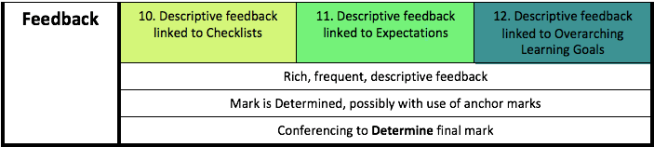
Gradeless Model 10: Tasks and Feedback

  • Descriptive feedback is given, linked to checklists.
  • Rich, frequent descriptive feedback is given.
  • Conferencing occurs at end of course to determine final mark, possibly with use of anchor marks.

None of those interviewed provided descriptive feedback-based on task criteria. This may be because task criteria are commonly communicated as a checklist, with little need for further information to be communicated.

Gradeless Model 11: Curriculum Expectations and Feedback

  • Descriptive feedback is given, linked to course expectations.
  • Rich, frequent descriptive feedback is given.
  • Conferencing occurs at end of course to determine final mark, possibly with use of anchor marks.

Four interviewees made use of descriptive feedback that related specifically to curriculum expectations, but with no level or measure attached. These teachers represented a range of subject areas including English, physical & health education, visual arts, and geography.

Gradeless Model 12: Overarching Learning Goals and Feedback

  • Descriptive feedback is given, linked to overarching learning goals.
  • Rich, frequent descriptive feedback is given.
  • Conferencing occurs at end of course to determine final mark, possibly with use of anchor marks.

Three of the teachers interviewed had moved almost exclusively to the use of descriptive feedback, relating to four or five overarching learning goals for their course. Their subject areas included music, drama, French, and mathematics.

While some of those interviewed utilized one tool consistently throughout their assessment process, many made use of two or three different gradeless models, with one teacher reporting use of six of the gradeless models in his various courses.

What’s next?

I hope that one of these models might be a starting point for YOUR shift away from marks towards a competency-based feedback model.

School Online – Journal – Day 7 and a half….

Well, you know we are in a “new normal” when emails are sent out at 4:37 on a Saturday, to respond to changes since Friday.

Our teachers received an email, ahead of the posting of a letter to parents on our board’s website, letting them know that our online population has grown from 54,000 to more than 64,000 in the past week, and so additional time will be needed to build a new timetable, to ensure an equitable and successful start for all staff and students.  For our secondary folks this means that their students will work on a cross-curricular independent inquiry project aligned to our core subject, which can then be reviewed by teachers as a pre-instruction assessment, to gauge where students are in their learning.  Students will have access next Tuesday, will receive their timetables by the end of the week, and will join their classes the following Tuesday.

I’m hoping that this additional time will provide a respite for them, following four days of COVID orientation in their community schools.  And knowing that they will have some time to prepare before launching their synchronous classes should offset the anxiety that this uncertainty might be generating.

I’m thinking that, if this trend continues, we should change our language from “excessed” from the community school to “seconded” to the Online School.  I’m also imagining that for some teachers the fully online will have some appealing features missing from the hybrid community school model.  They will see their students every day.  They will be working with a full class each day, rather than half. They will be able to create a scope and sequence and then follow it in a cycle between synchronous and asynchronous. And they will be able to refine their online processes, and develop expertise.

And those in our community schools, where they see half a class on Monday morning, and the other on Thursday morning, with asynchronous between, and a synchronous session on Tuesday and Friday, will have a more challenging planning task ahead of them. Three different learning environments within one class, and not always in the same sequence, will require that they abandon their linear approach.  It’s likely to be unsettling, but I think it will break down some of the routines, and promote creative solutions to better serve our students.

In both settings this promises to be a year of growth and learning, for both teachers and students.

School Online – Journal – Day 7

Isn’t technology fun? Maybe, or maybe not.

Here are some snippets from my Friday:

Welcoming new pre-service teachers to Ontario Tech University

  • Adobe Connect was new to them.
  • Several didn’t have earbuds or headphones, and so any audio from their speaker went back out their mic, creating a disconcerting echo. I’m hoping that they’ll have them on when classes start next week.
  • With almost 30 students, our thumbnail faces were literally “thumbnail” size.
  • This was the FIRST orientation activity where they were actually asked to speak to each other.  All previous had been webinars…. three days’ worth!
  • Result?  We had a great time getting to know each other.

Picking up a new laptop

  • I had to sign in and out at the board office.
  • I had to wait to be escorted, rather than heading to my meeting.
  • There were two of us in a huge room, both of us masked.
  • We were almost finished when I mentioned that I would be in a school next week, and found out that they then needed to add more to the setup so that I would be able to access Wifi.
  • Result? It works well…. except that you must be on the Internet to use many of the new tools.

Internet

  • As mentioned in a previous post, our ISP “up north” has disappeared.  And they billed me twice for last month, so I’m out a rather large sum of money.
  • So, when I made the trip up the 400, it was to a place with no connectivity.
  • Thank goodness for my personal phone and its data plan: I was able to tether to download, and send email.
  • Result? Headed in to town today, signed a contract with the ONLY LTE provider, and am now back online.

Data Tools

  • I was able to download the results of the Google Form survey of our online teachers, and bring it into Excel.
  • We made the survey simple for the teachers, but that made the data much more complex.  For example, when asked what courses teachers were assigned this year, some replied with course codes, and others with text descriptions.  And we asked one question, but received up to 8 data points.
  • I created columns for each subject, and then hand-entered the first letter of the subject (M for Math, E for English), as well as a few more specific codes.  What is the logic of having GLE as a special education course, and GLC as careers?
  • Once each record was coded, I was able to sort.  I then created a new worksheet for each subject area, and copied the teacher information to the new worksheet. 
  • Within each worksheet we may need to create more columns, in order to sort by specific course codes.  However, for many subject areas it may be sufficient merely to scan to pick out who wants to teach BOH4M0 or BTA3O0.

Timetabling

  • The building of the timetable is ongoing, and a gargantuan task with more than 9000 students and about 400 teachers.
  • Most of our most experienced timetabling Vice Principals are either retired, or have been promoted to Principal.
  • So, my contribution next week will be to fill in for one of the latter, who will join our School Online team in order to ensure we timetables for classes to begin next Wednesday.

It’s the weekend.  I finally have Internet again, and am capturing yesterday’s experiences before they disappear.  I’m looking for clothes to wear next week. It’s been six months since I wore my “Principal” costume, so I’ll have to dig.

On Monday I’m looking forward to experiencing our new hybrid secondary school model, where 50% of our students will attend for the morning, and then return home for both asynchronous and synchronous learning.  I’m going to learn all about PPE and distancing with teenagers!  And I would imagine that my afternoon will be spent trouble-shooting with our teachers who will be teaching synchronously for the first time from their classrooms, after working from home in the spring.

Because I also teach, in the morning I’ll be meeting my pre-service teachers, with whom I worked throughout the 2019-2020 school year, but this time it will be in Adobe Connect rather than at Ontario Tech University. I’ll be behind closed doors in the “Principal’s Office”, and if I’m interrupted by school staff it will just be a learning opportunity for my students.

I hope everyone is taking time for themselves this weekend, and doing something that relaxes and refreshes.  There are going to be a lot of new experiences next week for our students, for our F2F teachers, and for our Online School teachers.  I’ll be listening, observing, and learning along with all of you! I’ll let you know what learned in my next blog post.

Photo credit: Hans-peter-gauster-252751-unsplash.jpg

School Online – Journal – Day 6

Well it’s almost bed time for me, and I’m having to think hard to remember what my day looked like today. It started out slow, and then ended like a freight train!

As I mentioned earlier, our teachers don’t yet know what they will be teaching next week. So, a survey was designed to be sent out to our more than 400 secondary teachers, to request their input as we begin to assign teachers to classes.

Since we are a new school there are no distribution lists. So, I hand-keyed all the names, and hoped that our Outlook email system would find them accurately.  It did, for the most part, but there remain about 20 teachers whose names on our list don’t quite match their email names, and so they won’t have received the request to complete the survey.

It took me a couple of hours to copy and paste both the subject line and body text, and then to BCC each person. When it was done I breathed a sign of relief…. until I received the “gentle” email pointing out that I had identified this year as 2020-2012!  I must have copied that at least  10 times without noticing.

All I could do was laugh!

The survey will be due at the end of the day tomorrow, and then I’ll work with the resulting spreadsheet to create lists for each of the courses we offer, so that we can do our best to match requests to available classes.

That matching will take place on Saturday (no choice but to work the weekend), so that we can get the information out to teachers.  Fortunately the plan is to begin teaching on Wednesday, so they’ll have a bit of breathing space at the beginning of the week to plan, and to reach out to their students.

In my last post I talked about the challenges I anticipate. The one that is preoccupying me is how we create community for our teachers, so that they don’t feel isolated as they embark on a full year of distance learning.

I find that I do my best thinking in the middle of the night. So, it’s off to bed.

I hope your “school start” is going well, or at least as well as it can in these unique times.

School Online – Journal – Day 5

Day 5 for both our “bricks and mortar” schools, and our new Online School!

In person, our teachers are welcoming Cohort B of Grade 9 students, combining COVID training with our traditional welcome to secondary school. I can’t imagine what it’s like for our teens, heading off to “high school” in such a time.

Online, we are still awaiting creation of our timetable for almost 9000 students.  Did you know that software developers have never considered this eventuality? So, there have had to be a lot of last-minute software tweaks, and many tasks have had to be “redone”.

Since we have no solid timetable, we haven’t yet been able to assign our teachers, so they are out there in limbo.  As an administrative team we are working to define our jobs.  We need to support our students and our staff, and ensure that the needs are met by a team of Principals and Vice Principals, some of whom are working part-time.

So what are the roles of Principal and Vice Principal? We are thinking that the Vice Principals might take responsibility for a group of students, probably according to the placement of their last name in the alphabet.  Our Principals primary work could be to support teachers and liaise with parents.  So they may be grouped according to subject areas, in order to create smaller communities.

However, some of these departments will be very large.  We estimate courses for students in a year to be 7.5. and teachers each lead 6 classes of anywhere from 22 to 31 students. So our 9000 students will require somewhere between 450 and 550 teachers. Tomorrow night is the deadline for students to opt to join our Online School, so our number of teachers may grow as well. For English alone we are looking at 50 to 60 teachers.

It is hoped that teachers will know their assignments as of the weekend, and will have Monday and Tuesday to prepare before classes formally begin on Wednesday. But since this is still a tentative plan, the communication is awaiting confirmation, and our teachers’ anxiety is growing.

My role as a Principal will be to allay their fears, find out what my teachers require, and figure out how to get it to them as soon as possible.  They will be learning to use an LMS (Learning Management System), refine their use of Google Meet or Microsoft Teams, collaborate with others who are teaching the same course (many of whom they will never have met), and then connect with their students (whose anxiety is likely similar, as they sit at home!)

Since we still have two more days this week, and there may not be much news, I’ll take the next couple of blog posts to consider how I might support my teachers and students, beginning next week.

How will I build community with my teachers?

How will I support teachers to utilize research-based, student-focused instruction and assessment strategies?

How will I support the Mental Health of my teachers, and their students?

More questions than answers right now!

School Online – Journal – Day 4

After the long weekend, we teachers expect to head back to school, meet our students, and embark on the new school year with excitement and optimism.

This year is different.

Teachers in “bricks and mortar” schools in our district are spending this week orienting students to the new reality of COVID-19. Today they welcome Cohort A of the grade 9’s, and tomorrow it will be Cohort B of grade 9.  Thursday and Friday will Cohorts A and then B of grades 10, 11 and 12. They won’t be together as a class until next week, and then it will be the start of the “Quadmester” rather than “Semester”. Students will be enrolled in two courses, and they will be at school for two mornings, and working both asynchronously and synchronously at their computers at home for the rest of the time. So, teachers will be doing icebreakers and syllabus review for their four groups on Monday, but some will be F2F, some will be asynchronous, and some will be synchronous. No longer can they plan one “Day One” lesson.

But these aren’t even the School Online teachers. These are the teachers who are remaining in the “bricks and mortar” schools, to teach 83% of our secondary schools.

The School Online teachers don’t yet know what they will be teaching, have not yet been told who will be their administrators, and have received no training. They remain in their Home schools, doing primarily hallway supervision and directing the flow of students.  Not a very exciting or inspiring way to begin the school year!

So, today we meet as an admin team.  I am hoping that timetables have been built, and that teachers will soon learn their assignments.

Our “bricks and mortar” teachers can begin to plan their new repertoire of instruction, with some content provided F2F, some asynchronously, and some synchronously.  Since they have Cohort A and Cohort B of the same class, they are also going to need to duplicate the same content and activity in more than one mode, if they wish to follow the same scope and sequence. Or, they are going to have teach in lessons that do not have to follow a specific sequence, if they wish to use the same asynchronous content for both Cohorts. And since Wednesdays will be a “bonus” day for each of the four groups, as soon as we complete week 2 the groups will be out of synch. So many things to consider!

One of our district teachers has built a beautiful planning spreadsheet to help. Check out the twitter account of @miss_jtoor, and her Google Sheet at bit.ly/338150a. It’s wonderful to see teachers make sense of their new reality!

But our School Online teachers are in limbo, so their anxiety is growing. They don’t know what they are teaching. They don’t know who they will be teaching. They don’t know their schedule, beyond 8:30 to 2:30. And it is the first day of school!

Tomorrow I will share more details of both our hybrid “bricks and mortar” schools and our online school.

School Online – Journal – Day 3

It is still the traditional “week before school starts”, but this is one of those unusual years the occur once every six years where we need days before Labour Day in order to fit all of the school days between Labour Day and the end of June.

So today is Day 3 for our teachers, who are concluding all of the health and safety professional learning that is necessary to keep our students safe. It’s now mostly online, so many of them are completing it at home, and then heading into school to attempt to make their rooms safe. Many will be trying to achieve physical distancing that is mathematically impossible within their crowded classrooms.

So, perhaps those who have been declared excess to their schools, and who will soon learn that they will be joining our online school, will be relieved. I’m thinking a lot about how our new online school will be unique as we build it with teachers who were at the lowest on our seniority lists, and students whose parents fear for their safety in our “bricks and mortar” schools.

And it will be my job, as their Principal, to make it the best learning experience for students and teachers.

So, what did I learn on Day 3?

  1. When you are kicked out of your “class” you need a back-channel to let your teacher know. When I had to leave my Final Oral Examination (aka Defence), my advisor needed to reach me via cellphone to let me know to come back in. How will our students contact our teachers if their Internet goes down, or their device crashes?
  2. Sitting for 90 minutes in front of a camera is hard on the neck. Now, mind you, this was an exam. But for many of our students their interactions with their teachers feel like an exam. How can we support our students to sustain their attention, and remain physically healthy?
  3. When the class ends, so does the social connection. In a “bricks and mortar” school, the conversation continues as we head out of class, and out to the bus or car. That easing, and gentle shifting of focus, is important. How jarring will it be for our students to say goodbye, take off the headphones, and be back in their home world?

My online session ended with congratulations from my examining committee and a new title, “Dr. Whitmell”.

But the feeling when I closed my laptop, and took off my headphones, was a strong wish to be with people, not sitting alone in a room. I felt let both let down and frustrated, with excited and relieved. How will I, as one of our online school’s leaders, support my teachers and my students once our school day ends?

School Online – Journal – Day 2

Today’s Professional Learning began with my joining the staff of one of our “bricks and mortar” schools, working through a PowerPoint presentation in Zoom. With 100 staff in the room, and only about 20 with cameras on, it was an effective and somewhat relaxing way to begin the day. I thought a lot about how they might be feeling, connecting with their colleagues, but sitting at home.

They then headed out to do a training module that was not required of administrators, so I jumped into tomorrow’s package, and worked my way through a full-day’s-worth of PD over the next five hours. It was nicely put together, with several videos followed by reflections.

In between sections of the agenda I was checking my email (I now have six accounts I have to monitor between my grad program, school, pre-service teacher courses, and personal account) and getting set up for tomorrow.

Tomorrow I will be completing my PhD Final Oral Exam, via Zoom. I am at the end of five years of study, and very excited to have reached this milestone.

I’ll let you know how it turned out in tomorrow’s post…..

School Online – Journal – Day 1

September 1, 2020 was a day unlike any other since I began “school” at age 5 in 1965. While students remain at home, our teachers have begun the first of three Professional Learning Days. But, unlike other years where we have met prior to the Labour Day Weekend, this one began online.

We were all online, viewing a welcome message from our Director of Education. Then we completed COVID-19 training and WHMIS training, with choices of video, slide presentation, or text.

Those heading back to “bricks and mortar” schools were then permitted to attend a staff meeting… but only 50 at a time in a physically distanced space. Next week that all changes when our elementary colleagues welcome classes as large as 30 into very small classrooms! ….but I digress.

Our online teachers didn’t yet know that they are our teachers. They found out that they are “excessed” at the end of today, after they had already met with half the school staff, and then with their departments. And they know little beyond the fact that they will now be leaving their school as of Friday. We have 8200 students joining us, so you can imagine how many teachers headed home to share with family that all that they had planned for this fall has changed.

Those of us who do know that we are working online, along with those who are occasional teachers, then headed on for more online learning: Anaphylaxis, Concussion, and Asthma. The last two are provided by a central organization whose servers could not keep up. So I did that training before bed.

I am excited at the prospect of working with teachers to extend their skillset in this new online environment. I wish I could whisper “it’s going to fun” to each of the teachers who learned today that they are “excess”, so that they don’t spend their nights worrying.

And I’m excited that we will be working with new tools, in a new way, and will be learning together.

But, in the meantime we have to wait until timetables are built, teachers are assigned, and we figure out how we will work as a team to support them and their students.

So, I’m awake at night as well, imagining scenarios, and brainstorming ways to utilize our technology in service of learning, connection, and growth.

I’m hoping to document our journey in a series of blog posts: three this week, and then daily after the Labour Day Weekend. Please comment, or contact me directly, to add your perspective, or to ask any questions about the new path we are building for our students.